

Table of contents of the article:
Anyone who hosts an e-commerce site knows this scenario well. The server is loaded, the PHP processes are all busy, the database is churning out query after query, yet Google Analytics says there are forty people on the site. You open the logs and the answer is always the same: thousands of requests per minute to URLs like /scarpe/?colore=nero&taglia=42&prezzo=50-100&ordina=prezzo&p=7It's not an attack in the classic sense. It's a crawler exploring, combination by combination, the catalog's faceted navigation.
Faceted navigation is an excellent tool for people and a bottomless pit for bots. Until a few years ago, the problem mainly concerned Googlebot and a few SEO crawlers. Today, it has exploded, with the arrival of crawlers from artificial intelligence companies, many of which do not respect the rules the web has established over thirty years, and some of which masquerade as normal browsers to avoid recognition.
In this article, I try to explain the problem from the perspective of server managers, why it's not a good idea to leave filters open even for "good" bots, what Google recommends, and why the promise of "serving bots from cache," which some people sell as a solution, doesn't hold up to the test of numbers.
What is faceted navigation and why does it generate infinite URLs?
Faceted navigation is the filter system you find on the left or at the top of almost every catalog: brand, color, size, price range, material, availability, and products on sale. Each time the user selects a filter, the platform generates a new URL with a new parameter. WooCommerce, Magento, and PrestaShop all use this, each with its own syntax.
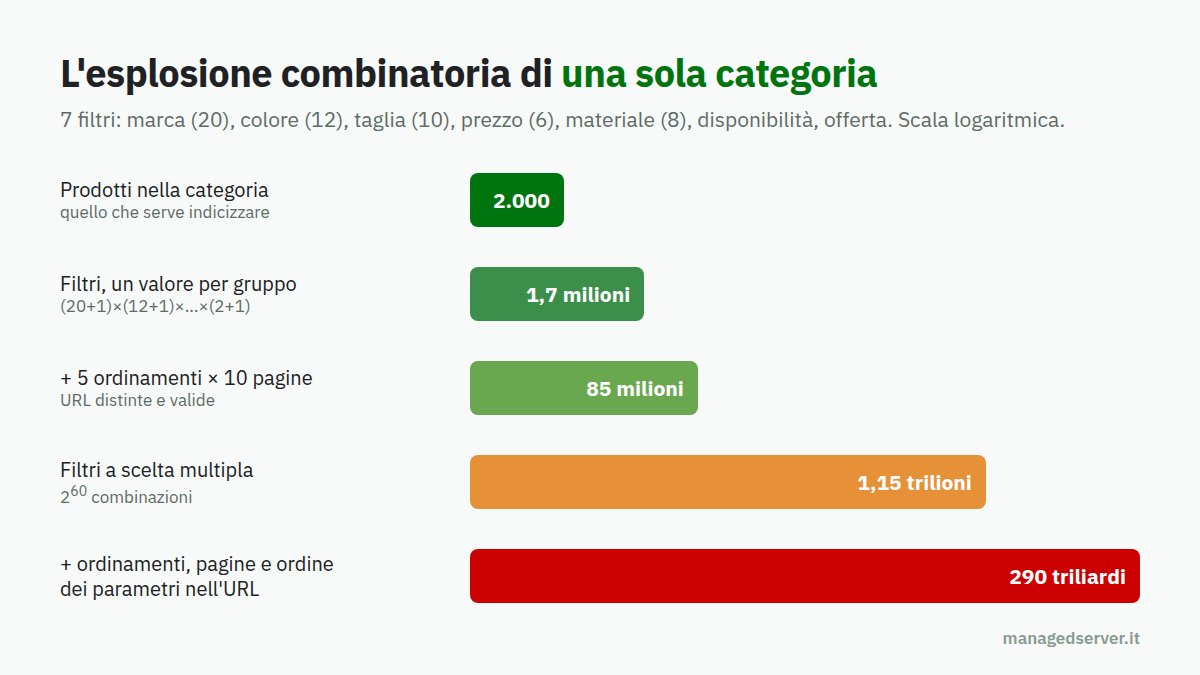
The point is that each filter combination is a different URL, and the combinations grow multiplicatively, not additively. Let's take a single category from a shoe store with seven filter groups: 20 brands, 12 colors, 10 sizes, 6 price ranges, 8 materials, availability yes or no, on sale yes or no. There are 60 values in total.
- If the user can choose only one value per group, le combinazioni sono (20+1)×(12+1)×(10+1)×(6+1)×(8+1)×(2+1)×(2+1) = 1.702.701.
- Let's add 5 sorts and 10 pages of results: we get to 85 million URLs distinct and perfectly valid.
- If the filters are at multiple choice, as almost always happens with colors and sizes, each value can be turned on or off: 260 = 1.152.921.504.606.846.976 combinations, that is, approximately 1,15 trillion.
- If the platform does not normalize the order of the parameters,
?colore=nero&taglia=42e?taglia=42&colore=neroThey are two different URLs. With sorting, pages and permutations of the seven parameters you overcome the 290 trillion.
All this for a category that contains, perhaps, two thousand products. There are two thousand useful contents; the reachable URLs are a number that no longer makes any physical sense.
The problem seen by the server
A filtered category page is one of the most expensive pages an e-commerce site can generate. It's not enough to simply browse a product: you have to apply filters, count the results for each filter value (the famous numbers in brackets), sort, paginate, and calculate prices and availability. In Magento, you traverse attribute and index tables; in WooCommerce, you traverse taxonomies and metadata; in PrestaShop, you traverse layered navigation modules. On large catalogs, a single filtered page can require anywhere from a few hundred milliseconds to several seconds of CPU time and dozens of database queries.
Let's do a conservative calculation: 0,3 seconds of CPU time per page. A crawler visiting a million combinations per day—a far from uncommon number for the catalogs we manage—expends 83 hours of CPU time a day just to generate pages that no human will ever see. This translates to saturated PHP-FPM processes, request queues, databases under pressure, increased response times for real customers, crashing shopping carts, and, in the worst-case scenario, the site going down during an advertising campaign.
This isn't an academic hypothesis. Google itself, in a review of crawling issues reported in 2025, discussed by Gary Illyes on the Search Off the Record podcast and reported by Search Engine Land , attributed about half of the issues to faceted navigation and another quarter to action parameters like sorting and shopping cart. Three out of four crawling issues arise from URLs generated by filters and parameters.
New AI Crawlers: No Crawl Delay, Little Robots.txt, Lots of Disguises
For years, the pact between sites and crawlers has been based on two tools: the robots.txt file, which states what can be crawled, and the directive Crawl-delay, which asks to slow down. Both are courtesy requests. No one forces a crawler to comply with them.
The first detail that many people ignore is that Google doesn't support the crawl-delay directive at all : its documentation in robots.txt explicitly states this. Bing and a few others consider it, but for a large portion of modern crawlers, it's just a line of text with no effect.
The second detail is more serious. With the rush to use data to train and feed AI models, crawlers have emerged that ignore robots.txt or interpret it in their own way. We've already discussed this in this article about AI that doesn't respect robots.txt and in this one about how half of web traffic is no longer human.
The most well-documented case is one Cloudflare published in August 2025 on Perplexity. According to Cloudflare's report , when the declared crawler was blocked, an undeclared crawler, with a generic user agent that mimicked Google Chrome on macOS, was deployed from IP addresses outside the published ranges, and IPs and networks were rotated to circumvent the blocks. Cloudflare also reports that robots.txt was ignored or not even downloaded. Perplexity disputed those findings, but the behavior described is exactly what we observe every day in our customers' logs, from many different sources.
From the server's perspective, this changes everything. A bot that pretends to be Chrome, rotates residential IP addresses, and ignores robots.txt cannot be distinguished from a client by the user agent alone. And a bot that doesn't know the catalog, isn't in a hurry, and doesn't have a crawl budget follows every filter link it finds, generating precisely the combinations no real user would ever generate.
Why it's not worth leaving filters open even to Google, Claude, Meta and OpenAI
The instinctive reaction is to distinguish between good bots and bad bots: we block the ones that hide and let Googlebot, Bingbot, ClaudeBot, Meta-ExternalAgent, GPTBot, and the other declared crawlers pass. This is correct for products and categories. It's a waste for them as well for filters.
Let's think about what a search engine or an AI assistant needs to navigate a catalog. It needs each product page, with name, description, price, availability, and structured data. It needs category pages, which organize and connect the products. That's all. The page "black leather shoes, size 42, between 50 and 100 euros, sorted by price, page 7" contains no information that isn't already present in the individual product pages. It's a subset, a temporary view, almost always duplicate or poor content.
This is why the filtered catalog doesn't need to be indexed: it's the set of product pages that needs to be indexed. And product pages, unlike filter combinations, are a finite, stable, and repeating set, which a standard web cache like Varnish handles very well. The bot that reads the product page receives it from the cache in a few milliseconds; the bot that explores the filters forces the server to calculate a new page each time, resulting in neither ranking nor visibility in AI responses.
Leaving filters open to Googlebot also has a real SEO cost: the time Google spends crawling useless combinations is time it doesn't spend on new or updated products. Google itself states this, as we'll see immediately.
What Google recommends about faceted navigation
Google has a dedicated page, "Managing crawling of faceted navigation URLs ," and it's surprisingly clear. It explains that crawlers visit a very large number of them before realizing that these URLs are useless, that crawling faceted URLs tends to cost sites large amounts of computing resources, and that time spent on useless URLs is taken away from new, useful URLs.
The recommendations are divided into two cases.
If you don't need the filtered pages to be indexed , which is the case in almost all e-commerce sites:
- Block filter parameters with robots.txt, leaving the unfiltered listing page crawlable. Google writes that there's often no good reason to allow filtered items to be crawled;
- alternatively use URL fragments (the part after the character
#) for filters, because fragments have no effect on the scan; rel="canonical"erel="nofollow"They help, but Google generally considers them less effective in the long run; furthermore, for nofollow, every single link to that URL must be nofollowed.
If you need some filtered pages to be scanned and indexed :
- use the standard separator
&between the parameters; - always keep the filter order the same and avoid duplicate filters in the same URL;
- return a 404 when a combination produces no results, when it is duplicated or nonsensical, or when pagination goes beyond the last page, without redirecting to a generic page.
Notice one thing: the noindex It doesn't appear among the tools for reducing crawling. A noindexed page still needs to be downloaded to read the noindex. From the server's perspective, the cost of generating it remains the same.
The false promise: “we serve bots from cache”
A few days ago, we analyzed an ad for a hosting provider offering to serve AI crawlers from cache instead of blocking them . It's not the only one: the idea is circulating, and it's commercially attractive because it promises no choice. The bot passes, the store doesn't suffer, and everyone is happy.
The problem is that a cache only works if the same resource is requested multiple times. That's its definition: the first request pays the generation cost (MISS), subsequent requests are served from the copy (HIT). It works beautifully on a finite set of pages requested by many users, such as the home page, categories, and product pages. It can't work on a set of URLs containing trillions of elements, where a crawler visits each combination only once.
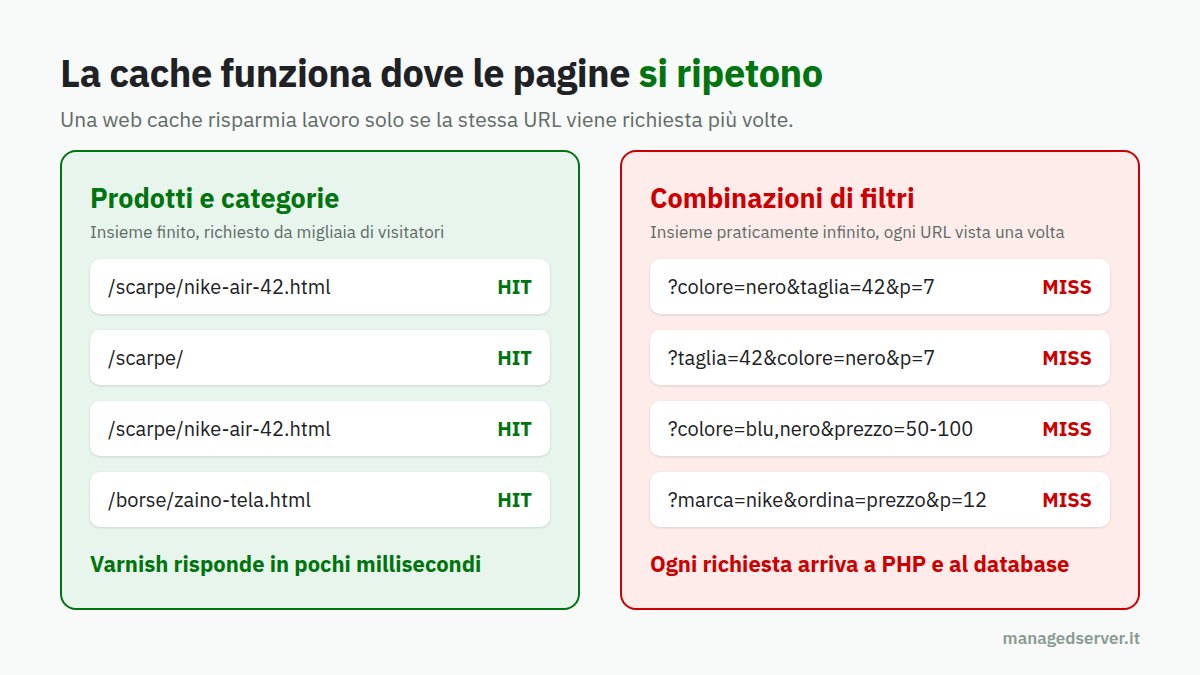
Let's go back to the previous example. To cache in advance the 1,15 trillion combinations of a single category, even at 50 KB per page, would require approximately 57 zettabytes of space, or 57 billion terabytes. Generating them, at 0,3 seconds each, would require approximately 11 billion CPU years. And if you don't generate them in advance, every first visit by the bot is a MISS: precisely the costly case the cache was designed to avoid.
Then there's a detail that makes the promise even more fragile. Prices change, availability changes, products enter and exit the catalog. A cache of filtered pages would have to be continuously invalidated, and each invalidation resets everything to the starting state. The cache doesn't reduce the number of combinations: it only shifts the problem from the CPU to memory, and even that's not enough.
Anyone who sells "bot cache" on filters without disclosing how many URLs are actually served from the cache, with what hit ratio, and on which catalog is selling a label. The store pays the price for that promise when bots continue to generate MISSES and real customers find the site slow.
What to Really Do: The Strategy of a Hosting Company That Knows Its Catalogs
The solution isn't a single rule but a series of levels, each of which stops a different category of bots. None alone is enough, and order matters.
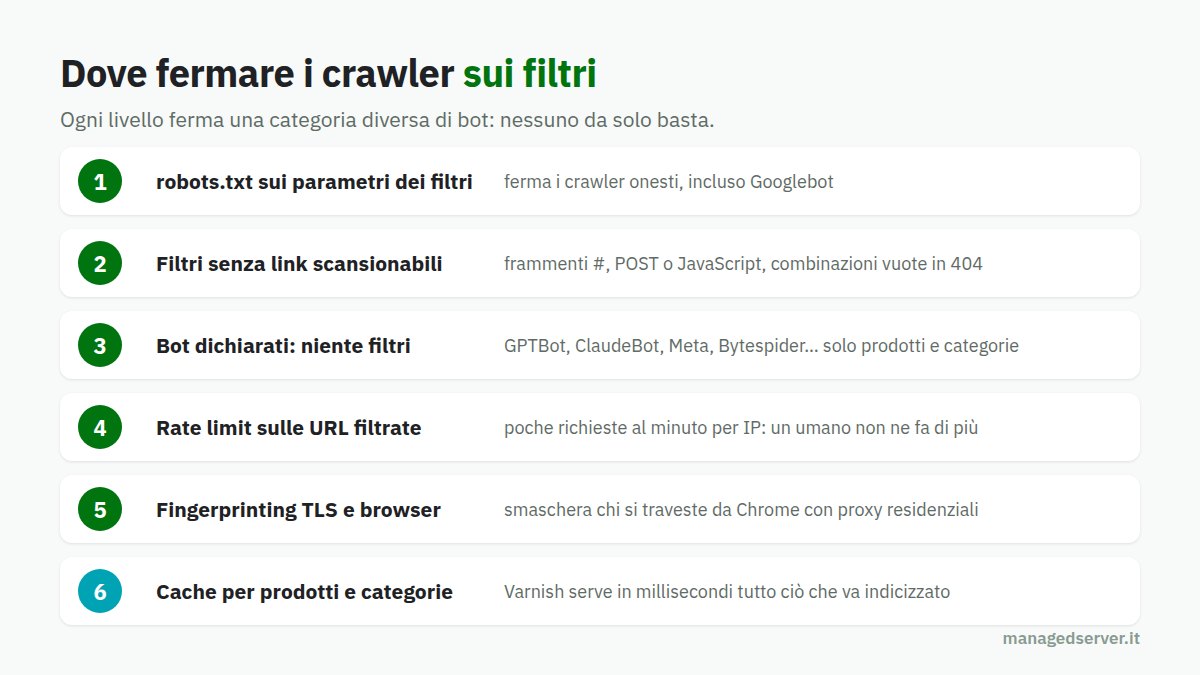
1. Close crawler filters with robots.txt
This is the first step and stops all legitimate crawlers, including Googlebot. Here's an example for WooCommerce, which you can adapt to your store's specific parameters:
User-agent: *
Disallow: /*?*filter_
Disallow: /*?*query_type_
Disallow: /*?*min_price=
Disallow: /*?*max_price=
Disallow: /*?*rating_filter=
Disallow: /*?*orderby=
Disallow: /*?*add-to-cart=
In Magento the layered navigation parameters depend on the catalog attributes (for example color, size, price, manufacturer) more product_list_order, product_list_dir e product_list_limitOn PrestaShop, the filters in the faceted search module usually go through the parameter qBefore publishing a robots.txt, always check that it doesn't block product pages, unfiltered categories, and CSS and JavaScript resources.
2. Don't offer crawlable links to combinations
If the filters are normal links, any crawler will follow them. If the combinations are managed with fragments, however. #, with POST requests or JavaScript that refreshes the page, simply don't exist for a crawler. Along with this, it's a good idea to normalize the order of parameters, limit the number of combinable filters, and return 404s for empty combinations, as Google requires.
3. Declared bots read products and categories, not filters
GPTBot, ClaudeBot, Meta-ExternalAgent, PerplexityBot, Bytespider, Amazonbot, CCBot, and other self-proclaimed crawlers can and must be able to read product pages, which arrive from the cache. For filtered URLs, however, the correct response is a 403. The same principle applies to Googlebot and Bingbot, with one caveat: verify that they are genuine using reverse DNS, because Googlebot's user agent is the first thing fake bots copy.
4. Limit the rate of requests to filtered URLs
A human doesn't open thirty filter combinations per minute. A rate limit applied only to URLs with filter parameters doesn't bother customers and hinders those who explore the catalog indiscriminately. On NGINX, for example:
map $args $ms_filtri {
    default 0;
    "~(^|&)(filter_|query_type_|min_price|max_price|rating_filter|orderby)" 1;
}
map $http_user_agent $ms_bot_dichiarato {
    default 0;
    "~*(gptbot|claudebot|meta-externalagent|perplexitybot|bytespider|amazonbot|ccbot)" 1;
}
map "$ms_filtri:$ms_bot_dichiarato" $ms_blocca {
    default 0;
    "1:1"   1;
}
# chiave vuota = richiesta non conteggiata: il limite vale solo per le URL filtrate
map $ms_filtri $ms_chiave_filtri {
    0 "";
    1 $binary_remote_addr;
}
limit_req_zone $ms_chiave_filtri zone=filtri:10m rate=20r/m;

server {
    # ...
    if ($ms_blocca) { return 403; }
    limit_req zone=filtri burst=10 nodelay;
    limit_req_status 429;
}
This is a practical example: in production, rules must be built on the store's real parameters and verified against logs.
5. Unmask those who disguise themselves
The previous levels don't stop those who pose as Chrome from a residential address and change IP addresses with every request. Here, we need tools that look beyond the user agent: TLS fingerprinting , which recognizes the libraries used by bots even when they claim to be a browser, and browser fingerprinting , possibly with a lightweight JavaScript check only on deep filter combinations. We also discussed this in How to build effective anti-bot systems.
6. Cache where it's really needed
Once the filters are closed, the cache goes back to its job: serving home pages, categories, and product pages to customers and bots in a matter of milliseconds. This is where a web cache like Varnish shines, with extremely high hit ratios, because the set of pages is finite and in high demand.
Conclusions
Faceted navigation was created for people and must remain for people. Search engines and AI assistants need product pages and categories, not filter combinations, and product pages work very well with a traditional cache. Combinations, on the other hand, are a set that grows to numbers that no longer have any physical meaning: no cache can contain them, and no server should generate them for a bot.
Blocking bots on filters isn't a defensive or lazy choice: it's the only choice consistent with the numbers , and it's exactly what Google suggests. Everything else, including promises to "serve bots from cache," is marketing that shifts the cost to the customer.
If your e-commerce site is experiencing abnormal load, unexplained slowdowns, or traffic spikes that aren't converting into sales, it's very likely someone is exploring your filters. On platforms like WooCommerce , Magento , and PrestaShop, we analyze logs, identify crawlers, and build custom catalog rules, without losing product visibility.

