
Table of contents of the article:
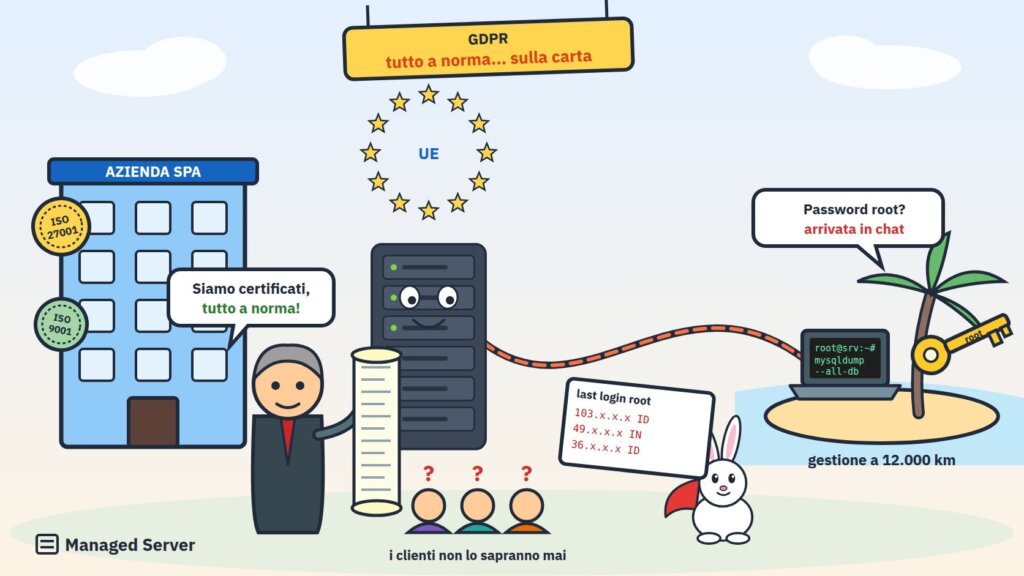
On paper, the GDPR is one of the most beautiful data protection laws ever written. Clear principles, precise responsibilities, individual rights, and fines of up to 4% of global turnover. In practice, at least for those who actually tamper with servers, it's often a law that no one verifies and that almost no one fully complies with.
We're not saying this out of prejudice. We say it because our work takes us inside other companies' systems every day: system support, migrations, optimizations, incident analysis, and recovery of compromised sites. And when you access a server, the server always tells you who was there before. Where they connected from, with which user, with what privileges, and what they left lying around.
What the logs tell, too often, is a story that the customers of those companies will never know.
“Compliant” companies
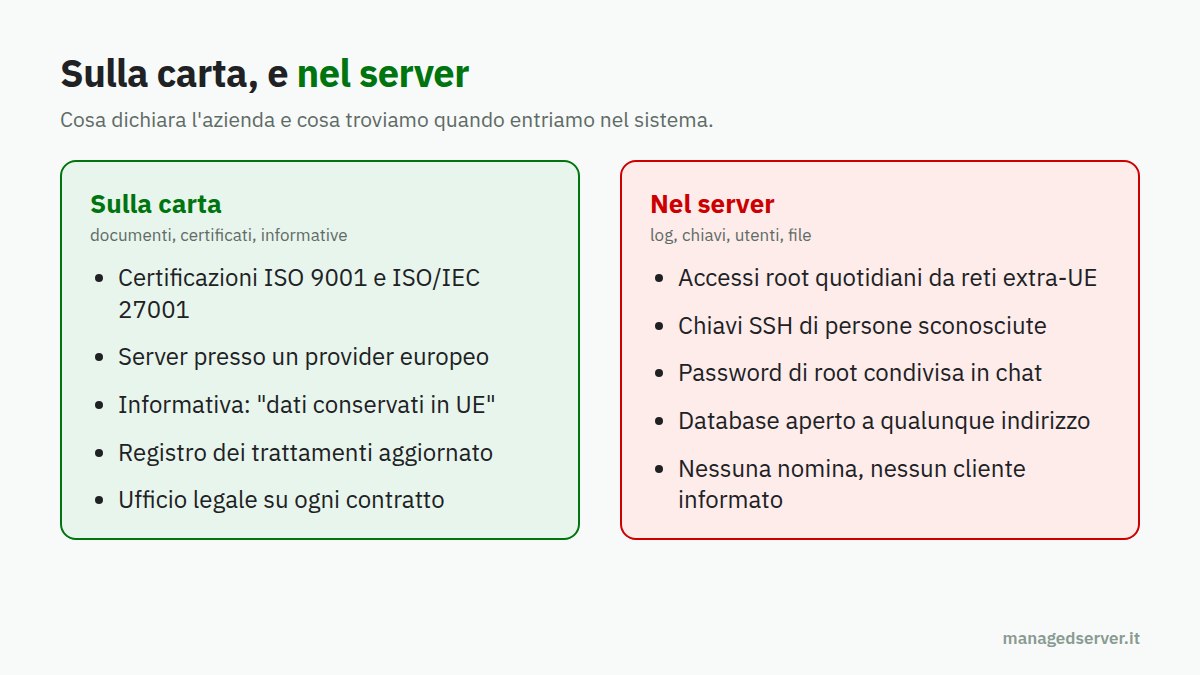
We're talking about a very specific and widespread type of company. It provides subscription services, manages a major e-commerce site, and a platform with hundreds of thousands of registered users. It generates millions in revenue. Its homepage displays the ISO 9001 and ISO/IEC 27001 certification logos, and perhaps even others. It has impeccable management control, documented quality procedures, and an in-house legal department or a reference firm that is involved even in signing the most basic supply contract.
Renewing a software subscription requires three rounds of clause review. Accepting a supplier's offer requires the qualification form, verification of the company's business records, and the appointment of data controller, signed in triplicate.
Then you look at who actually manages the server that runs the website, the customer database, orders, invoices, and uploaded documents. And you discover that day-to-day management has been outsourced to low-cost offshore personnel in Indonesia, India, or similar countries, chosen for their hourly rate and logged in with a root password.
Servers in Europe, keys elsewhere
The pattern is almost always the same, and looks perfectly respectable.
The Italian company purchases a dedicated server or VPS from a reputable European provider, with data centers in Germany, France, or Finland. It signs a data processing agreement with the provider, which is compliant. It specifies in its privacy policy that the data is stored on infrastructures located in the European Union. So far, so good.
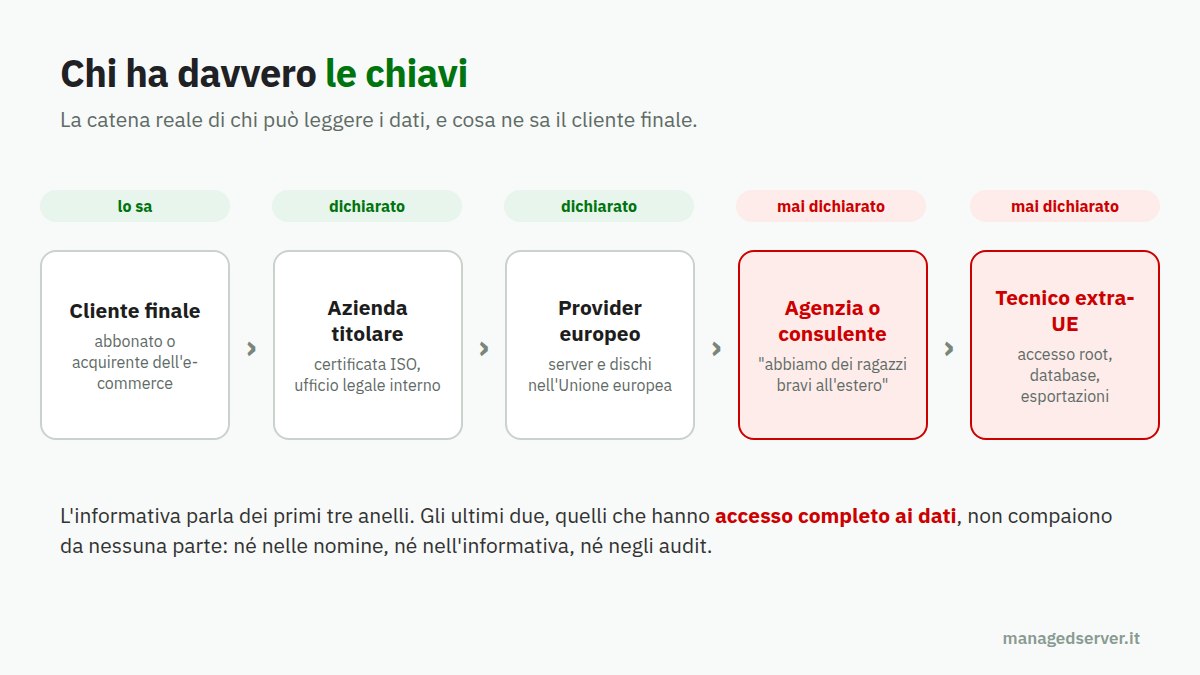
But the server needs to be managed: updates, configurations, backups, site issues, database changes. And this is where the shortcut comes in. Management is entrusted to an agency that in turn subcontracts, to a consultant who "has good guys abroad," or directly to a freelancer found on Fiverr or a similar platform. The first to respond, the lowest price.
From that moment on, the data is "in Europe" only in the sense that the discs are located in Europe. Anyone who reads, copies, exports, and modifies it is on the other side of the world. Without a contract, without an appointment, without anyone ever having declared it to their customers.
How do we notice it?
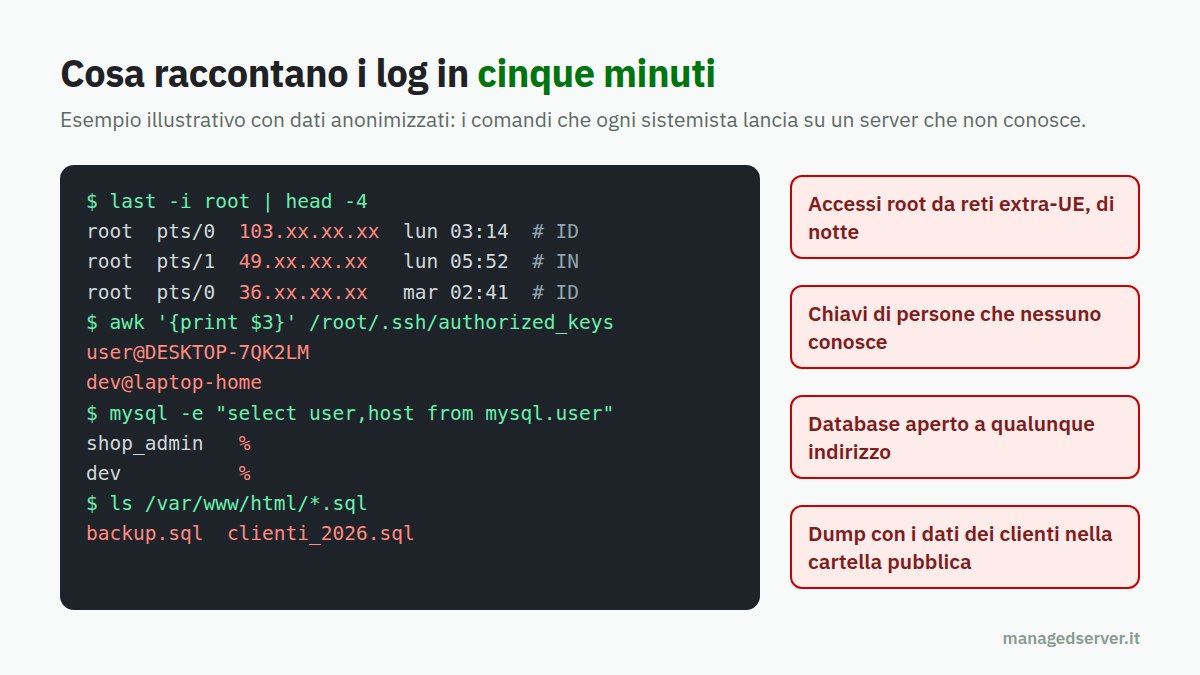
No investigation is necessary. The commands any system administrator would run in the first five minutes on an unfamiliar server are sufficient.
- The latest accesses. The SSH login history shows the IP addresses from which you connected. An IP search returns the operator and country. When root logins come in every day from Indonesian or Indian ISP networks, the picture is clear.
- The authorized keys. In the root SSH key file, we often find keys from people whose names the client doesn't even know, along with a comment left on the laptop of the person who generated them. No one knows who they belong to or when they were added.
- The database users. MySQL or MariaDB users with full privileges and access from any address, created "for convenience" to work remotely without going through the server.
- Panel and instrument logs. Access to phpMyAdmin, the control panel, and the CMS administration from non-EU IPs, with generic accounts used by multiple people.
- What's left on the disc. Complete database exports to a public folder, file as backup.sql o customers.csv forgotten after a job, scripts downloaded from who knows where, remote desktop tools installed and never removed.
- The credentials. The root and database passwords have remained the same for years, never changed after dozens of collaborators had changed, and were often shared via chat.
The point isn't that these accesses are necessarily malicious. In most cases, those working there are doing their job. The point is that no one in the company knows who has access to what. Not the quality manager, not the legal department, not the DPO almost never. And customers, obviously, even less so.
The problem is not Indonesia
It must be stated clearly, because the topic is susceptible to misinterpretation. In Indonesia, India, and many other countries, excellent technicians, well-structured companies, and professionals are more skilled than many European colleagues. The problem isn't the nationality of those employed.
The problem is the model. Choosing who will have access to hundreds of thousands of personal data with the same criteria you use to choose printer paper: price. Without verifying who the individual really is, how many people are behind the profile, where the credentials end up, or what happens to the data when the assignment ends. And above all, without telling anyone.
A company that outsources seriously, even to distant countries, signs contracts, appoints managers, evaluates the transfer, limits access, and declares it. A company that does so to save a few hundred euros a month usually does none of this.
What the paper says
Without going into legal technicalities, which we have already explored in depth when talking about low-cost IT outsourcing outside the EU , some principles are simple.
- One server in Europe is not enough. According to the European Data Protection Board's guidelines, making data remotely accessible to a separate entity operating from a third country constitutes an international transfer. The fact that the database remains physically in Frankfurt makes no difference.
- A clear legal basis is needed. Neither India nor Indonesia has an adequacy decision from the European Commission. The transfer therefore requires tools such as Standard Contractual Clauses and a concrete risk assessment.
- Whoever processes data on behalf of the company must be named. Article 28 requires a contract with the data processor, and the controller's authorization for any further subcontractors.
- Customers need to be informed. The information must indicate any transfers to third countries and the safeguards adopted. Anyone requesting access to their data has the right to know to which recipients their data has been disclosed.
- Security must be adequate. Article 32 addresses confidentiality, access control, and recovery capabilities. A root password shared in a chat doesn't fall under any definition of an adequate measure.
It's all written down, it's all clear. And this is precisely where the GDPR shows its greatest limitation: it's perfect at defining what must be done, but it has no realistic way of seeing what actually happens.
Because no one will ever know
In 2025, the Italian Data Protection Authority conducted 130 inspections, in line with the previous year. One hundred and thirty, for over four million companies operating in Italy. That same year, it was notified of 2.415 data breaches, more than six per day. These are the ones notified, meaning those that someone realized they had suffered and decided to report.
With these numbers, the likelihood of someone looking at who's logged in as root to an e-commerce server is, statistically, zero. And even in the event of an inspection, documents are checked: data processing records, information notices, appointments, procedures. These documents, in the companies we're talking about, are often impeccable.
The end customer, for their part, has no way of realizing this. They see a well-designed website, information about European servers, and certification logos. They'll never see the access log. If their data ends up for sale on a forum one day, no one will be able to trace where it came from. Most likely, not even the company itself, because those logs, when they exist, are neither stored nor viewed.
This is the true uselessness of the GDPR in practice. Not the principles, which are correct. But the complete lack of a mechanism to bring to light what happens behind the scenes. A system based on self-declaration only works for those who have already decided to behave properly.
Certifications don't look in logs
One wonders how ISO/IEC 27001-certified companies can get to this point. The answer is awkward but simple.
The regulation requires very specific controls on these very issues: security in relationships with suppliers, agreements with the ICT supply chain, privileged access management, and activity recording and monitoring. On paper, a scenario like the one described shouldn't survive an audit.
But the certification audit verifies the management system, on a sample basis, through documents and interviews. The auditor asks if there is a supplier qualification process, and there is. He asks if privileged access is recorded, and is shown a list. No one opens a session on the production server to compare that list with the actual SSH keys or the IP addresses of the most recent logins.
The result is a paradox we see all the time: the most well-documented company is often the one with the greatest gap between what it claims and what it actually does. This is because the documentation is handled by the quality department, while the server is "a technical thing" that has been delegated and forgotten.
The bill that comes after
Until nothing happens, the savings seem like a bargain. Then one day, something happens: a database exported and never deleted, a key left active after the end of a collaboration, a compromised account on the personal computer of someone no one has ever met. And the company finds itself having to notify a breach within 72 hours without knowing who had access, from where, and with what data.
At that point, the undeclared transfer, the unsigned appointment, and the false information all become a legal, as well as a technical and reputational, issue. And the legal department, which had requested three revisions for a stationery supply contract, discovers for the first time who had held the key to everything for the past few years.
What a serious company should do
You don't need huge budgets. You just need a few rules, truly applied and verified on the server, not on documents.
- Know who's coming in. A real access inventory: system users, SSH keys, database users, dashboard and CMS accounts. Periodically compared with the actual logins on the machines.
- Named access. No shared root passwords. Each person has their own user, with only the necessary privileges, and their activities are tracked. This is why serious managed services root password not delivered.
- Strong authentication and filtered access. Keys instead of passwords, second factor, access allowed only from authorized addresses or networks, database never exposed to the Internet.
- Fake data for developers. Anyone who needs to fix a theme or plugin doesn't need the actual database with customer data. Anonymized copies will suffice.
- Immediate revocation. When an assignment ends, access is closed that same day and credentials are changed.
- Consistent contracts and disclosures. If a non-EU provider accesses your data, it must be named, the transfer must be assessed, and the disclosure must be made transparent. If you don't want to disclose it, the correct answer is not to.
And a common-sense rule applies to suppliers: if a systems supplier can't tell you precisely which of their technicians are accessing your servers, from where, and with what privileges, the problem isn't the price they're charging you.
And the end customer?
Customers of a subscription service or e-commerce site have a tool that few use: requesting access to their data. The GDPR allows you to request which recipients your data has been shared with and, in the case of transfers to third countries, what safeguards have been implemented.
It won't solve the problem, but it will force the company to provide a written response. And for some, it might be the first time they've actually asked themselves that question.
How we work
At Managed Server, we provide Linux system support and manage dedicated servers for companies that rightfully expect to know who is using their infrastructure. Access is personal and tracked, the root password is not shared, and privileges are limited to those needed for the job at hand.
And when, upon accessing a new client's server, we find unexplained logins, unknown keys, exposed databases, or forgotten dumps, our first task is to report it. Of course, even when it's inconvenient. Because sometimes the most useful intervention isn't the requested optimization, but rather showing the client who really holds the keys to their home.
Conclusions
The GDPR gave people rights and companies rules. What it didn't provide was a way to verify that the rules are being followed where it really matters: on servers, in logs, in access. In that vacuum, companies that look impeccable on paper thrive, but to save money, they hand over the data of hundreds of thousands of people to whoever costs the least, without telling anyone.
It's not the exception. In our experience, it's become the rule. And as long as compliance is measured by documents rather than systems, it will continue to be so.
If you want to know who really has access to your infrastructure, the answer isn't in the processing log. It's in the server. And just look at it.

