

Table of contents of the article:
Once upon a time, building a CDN required a company: network engineers, peering agreements, an ASN, IP address blocks, hundreds of points of presence, and years of work. Today, all it takes is a subscription to an artificial intelligence assistant, a handful of VPSs around Europe, and a free afternoon.
This is how, in recent times, even the most unsophisticated systems engineers and hosting providers on the international scene have discovered CDNs. They asked AI how an edge network works, understood two or three basic concepts, and decided to build their own. A few nodes on Hetzner, one on OVH, one on Scaleway, a couple on Linode and DigitalOcean, a reverse proxy with active caching, a DNS that responds based on location. A nice logo, a sales page with a globe full of glowing dots, and the proprietary CDN is ready to be sold as an alternative to Cloudflare, Imperva, or Akamai.
Welcome to the DIY CDN clown circus.
Let's be clear from the start: there's nothing wrong with wanting to build a self-hosted CDN. In fact, it's a great style exercise, a way to demonstrate your ability to do things and offer something more than others. The problem isn't doing things. The problem is doing them poorly, selling them as if they were done well, and leaving customers to suffer the consequences, who in most cases don't even have the tools to notice.
What is a CDN really?
A CDN, or Content Delivery Network, is a network of geographically distributed servers located between visitors and the server hosting the website, called the origin. Each server in the network, called a POP (Point of Presence) or edge node, stores a copy of the content and delivers it to the visitors closest to it.
The problem it solves is physical, even before it's IT. Light in fiber optics travels at about two-thirds its speed in a vacuum, and packets never travel in a straight line: they pass through routers, switches, and undersea cables. A visitor in Milan connecting to a server in Frankfurt pays a handful of milliseconds for the round-trip. Someone in São Paulo or Sydney pays hundreds.
And those milliseconds aren't paid for just once. Opening an HTTPS connection requires a TCP and TLS exchange before even requesting the page: each round trip multiplies. The TTFB, the time between the request and the first byte of the response, is largely made up of these trips, plus the time the server takes to generate the response.
A CDN works on both fronts. The visitor opens the connection to a nearby node, so the round-trips are short. And if that node already has the page cached, the response is sent immediately, without disturbing the origin or waiting for PHP and the database. This is the concept of the edge: moving content, and possibly even some logic, to the edge of the network, as close as possible to the requester.
How to take a visitor to the right node
There are essentially two ways to direct a visitor to the nearest POP.
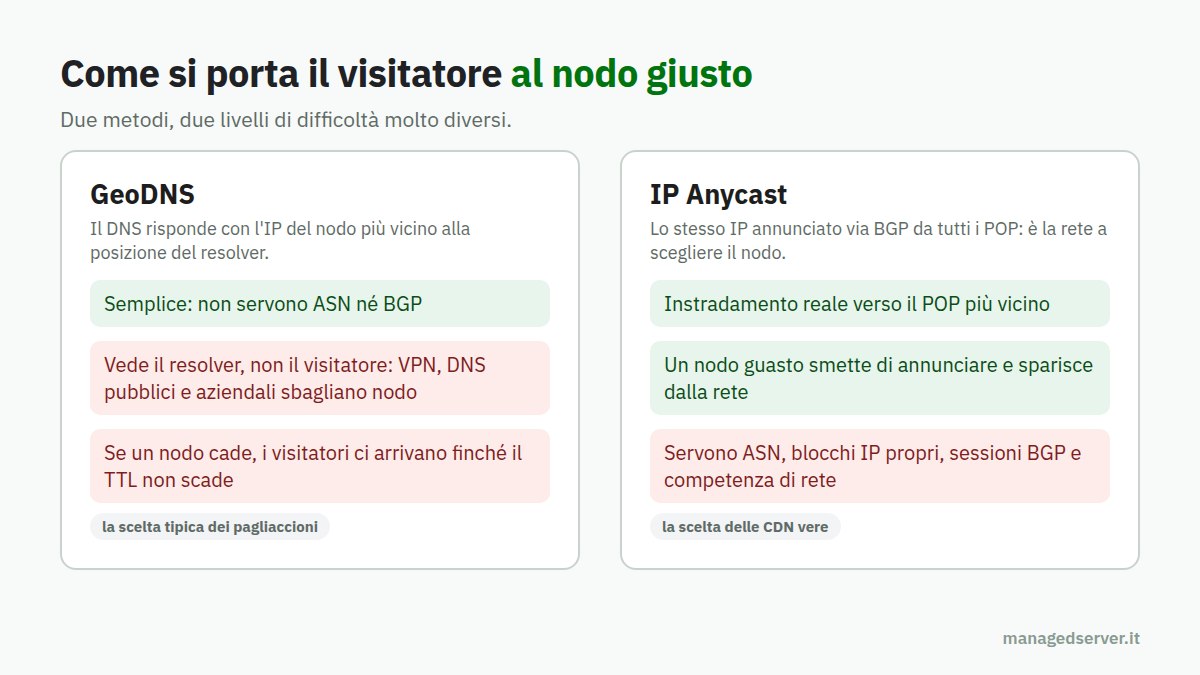
The first is GeoDNS . The DNS server answering the domain looks at the source of the request and returns the IP address of the closest node. It's simple and requires no special infrastructure, but it has known limitations: the location the DNS sees is that of the resolver used by the visitor, not that of the visitor themselves. Anyone using a public resolver, a VPN, or the corporate DNS of a branch office in another country could be sent to the wrong place. And DNS records remain cached in the resolvers: if a node goes down, visitors continue to be sent there until the TTL expires.
The second is IP Anycast , the method used by large CDNs like Cloudflare. The same IP address is announced via BGP by all points of presence simultaneously, and the Internet itself routes each visitor to the closest node in terms of routing. It works very well, but requires an assigned ASN, your own address blocks, BGP sessions with connectivity providers, and a certain level of networking expertise. We've discussed this in depth, explaining why Anycast routing is the foundation of every CDN.
The average clown, of course, uses GeoDNS. Not because it's a thoughtful choice, but because it's the only one he can configure. And up to this point, we could turn a blind eye. The real disaster comes later.
First question: do you really need a CDN?
Before discussing how to create a CDN, we should ask ourselves whether it's necessary. And here the clowns fail the first test, because they offer it to everyone, by default, as if it were always an improvement.
Let's take an e-commerce site that sells only in Italy, or at most in Europe, with a server in Germany. An Italian visitor experiences a few dozen milliseconds of latency to Frankfurt. If the site is served by a good origin cache, the TTFB remains well below the threshold that Google considers good, which is 800 milliseconds. In practice, with a well-designed cache, we're talking a few dozen milliseconds or a hundred at most.
Here's the point no clown will ever tell you: having 30 milliseconds of TTFB or 60 milliseconds doesn't change anything. It doesn't change conversions, it doesn't change Core Web Vitals , it doesn't change positioning. No customer abandons their cart for thirty milliseconds. A CDN, in this scenario, brings a marginal benefit in the best case. And as we'll see, it causes real damage in the worst case, which with makeshift CDNs is also the most common case.
The real problem: cold caches
A CDN is only fast when the requested content is already cached on the node the visitor connects to. This is a HIT. When the content isn't there, it's a MISS, and the node must do what a CDN is supposed to avoid: request the page from the origin, wait for it to be generated, receive it, store it, and only then deliver it to the visitor.
In a well-run CDN, MISS is the exception. In a CDN run by clowns, MISS is the rule. Why?
Because each node has its own cache, and the nodes don't talk to each other. The Milan cache knows nothing about the Paris cache, which knows nothing about the Madrid cache. Each page must be requested at least once on each node before being served quickly there. If you have ten POPs, you have ten caches to warm up. And pages that are viewed hundreds of times a day in Italy are viewed only once in a while in Warsaw or Stockholm: the copy expires before the next request, and that cache never warms up.
The result is a network that performs very well only where traffic is already high—that is, precisely where it's least needed—and performs terribly everywhere else. We've explained why it's not just about being present in a cache, but how often you find what you're looking for. Web Cache is nice, but the HIT ratio is better . With ten separate caches, that ratio doesn't divide by ten: it collapses.
The Italian reader in Paris
Let's take a concrete example. An Italian newspaper uses a DIY CDN with a node in Milan and one in Paris. The Milan node, with all the Italian traffic, has virtually every article cached: it's extremely fast. The Paris node receives very few visits: it has almost nothing cached.
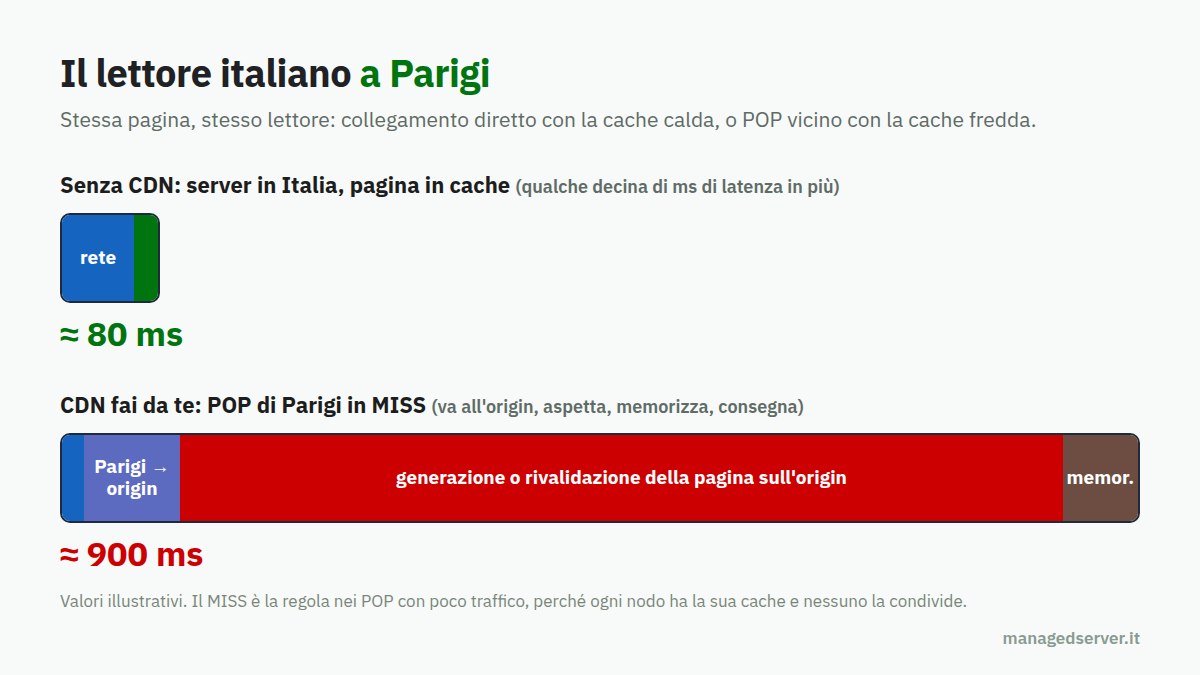
An Italian reader in Paris opens an article. GeoDNS sends it, correctly from its perspective, to the Paris node. The Paris node doesn't have the article. It must open a connection to the origin in Italy, request the page, wait for it to be generated or validated, receive it, store it, and only then begin delivering it to the reader. The reader pays for the latency to Paris, the latency from Paris to the origin, the generation time, and the storage time. Double latencies, plus server overhead.
If the same reader had connected directly to the server in Italy, it would have added a few dozen milliseconds of latency, say forty, but it would have received a cached page, served instantly. The clown spent money, time, and marketing to make that reader slower than it would have been without his wonderful CDN.
And if the origin doesn't have its own cache, because "the CDN is there anyway," every MISS becomes a complete page generation by PHP and the database: hundreds of milliseconds, sometimes seconds, for a visitor who should have been served instantly.
A real-life case of edge CDN built by clowns
Some might ask for proof to understand what we're talking about in practice. Let's take two sites: ours, managedserver.it, which doesn't use a CDN and relies on Varnish on the origin server, and a well-known hosting provider with its own proprietary CDN, which we'll keep anonymous and call, for example, "PAGLIACCIONE SRL."
Both sites were measured with SpeedVitals' TTFB test , which measures the response time of a single resource from different locations around the world. The resource can be an HTML page, an image, a font, a stylesheet, or a JavaScript file, making the tool useful for measuring the response time of an origin server or CDN globally.
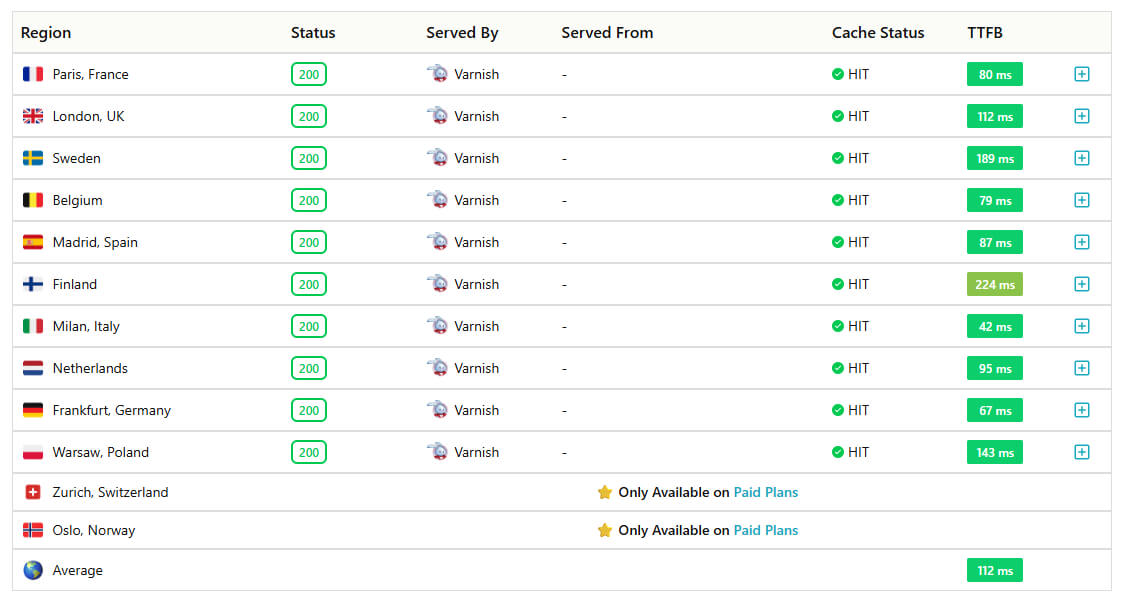
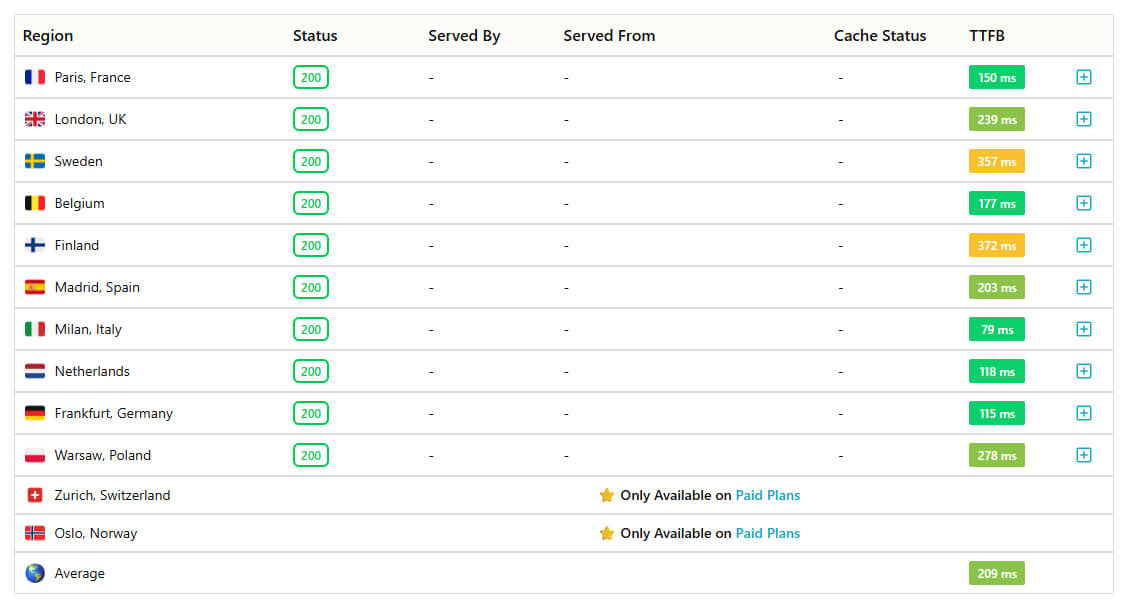
The numbers, location by location: in the CDN column the site with the proprietary CDN, in the Varnish column managedserver.it without CDN.
| Destination | CDN | Varnish | diff. |
|---|---|---|---|
| Paris | 150 ms | 80 ms | −47% |
| London | 239 ms | 112 ms | −53% |
| Sweden | 357 ms | 189 ms | −47% |
| Belgium | 177 ms | 79 ms | −55% |
| Finland | 372 ms | 224 ms | −40% |
| Madrid | 203 ms | 87 ms | −57% |
| Milan | 79 ms | 42 ms | −47% |
| Netherlands | 118 ms | 95 ms | −19% |
| Frankfurt | 115 ms | 67 ms | −42% |
| Warsaw | 278 ms | 143 ms | −49% |
| Media | 209 ms | 112 ms | −46% |
What the numbers say
The server without a CDN wins in all ten locations. There's not a single region where the CDN delivered a better TTFB. Not even in Milan, where the CDN takes 79 milliseconds versus the server without a CDN's 42.
The average TTFB drops by almost half. It goes from 209 to 112 milliseconds, about 97 milliseconds less, a 46% reduction. Conversely, with the CDN, the average TTFB is almost 87% higher.
The advantage remains even in the most remote locations , where a CDN should give its best:
- Sweden: 357 to 189 ms;
- Finland: 372 to 224 ms;
- Warsaw: from 278 to 143 ms;
- London: 239 to 112 ms.
In these measures, the presence of the CDN does not guarantee better response times even where the distance from the origin is greater.
The detail that says it all: the cache
In the managedserver.it test, each line reports Served By: Varnish and Cache Status: HIT : all requests, from all locations, were served from cache.
In the PAGLIACCIONE SRL CDN test, however, the Served By , Served From, and Cache Status columns are blank everywhere. The tool cannot identify the CDN, the node that responded, or whether the response came from cache.
To be fair, the absence of a HIT indication doesn't necessarily mean the cache isn't there: it could be there without being declared. However, a serious CDN makes itself known: it declares the node that responded and whether the response was a HIT or a MISS, as Cloudflare does with the header. cf-cache-statusA “CDN” that doesn’t even let you check whether it’s using cache is already a red flag in itself.
What can be concluded, honestly?
- In the measured sample, the server with Varnish and no CDN delivered the first byte faster from all ten European locations.
- The average difference is significant: about 97 milliseconds, 46% less.
- A centralized, optimized infrastructure with efficient HTTP caching can deliver excellent performance across Europe even without a CDN.
- There is no evidence that each CDN is inherently slower: to isolate the cause, you would need to compare the same content, certainly served from the cache in both cases, and repeat the measurements several times and at different times.
- The test only measures TTFB: it does not measure full load, static resources, Largest Contentful Paint or other Core Web Vitals.
The data refutes the idea that simply placing a CDN in front of a website will make it faster. A real CDN can provide benefits beyond TTFB, such as DDoS mitigation, static file distribution, and origin offloading. But what really matters is the efficiency of the cache and infrastructure, not the presence of a CDN on the commercial page. And when a proprietary CDN is slower than a single, geographically distributed server even in Milan, the problem isn't the CDN itself: it's who built it.
How real CDNs do it
Serious CDNs have known about this problem for twenty years, and they've solved it with architectures that clowns don't even know exist.
- Multi-level cache. In the event of a MISS, edge nodes don't go to the origin: they first request a higher-level node, which is larger and closer to the origin, which acts as a shared cache for an entire region. Cloudflare calls it Tiered Cache, others call it differently, but the principle is the same: a single request to the origin heats up the cache for many POPs.
- Choosing the path to the origin. The node that has to go to the origin does not do so randomly, but through the fastest nodes and paths at that moment.
- Persistent connections to the origin. Nodes keep open previously negotiated connections, so a MISS does not have to pay for opening a new TLS session each time.
- Rapid global invalidation. When you clear the cache, the request reaches all nodes within seconds, and there isn't an old version of the page left floating around somewhere in the world.
- Capacity and protection. Hundreds of points of presence, terabits of capacity, built-in DDoS mitigation, continuous monitoring of every node with automatic exclusion of unresponsive ones.
Now compare this list to six VPSs rented for a few euros a month, with shared vCPUs and shared disks (we talked about this in our discussion of low-cost VPSs ), an NGINX with caching enabled, a geographic DNS, and a business page with a globe. This is the distance between a CDN and its caricature.
Making a seeming CDN is easy, making it work is not.
Today, setting up a fake CDN, and advertising it as such, is easy. With the help of artificial intelligence, you configure reverse proxies, generate certificates, and write the GeoDNS zone file. In a couple of days, you have something that, at first glance, appears to work.
Implementing the features that really matter is another matter entirely: synchronizing or sharing caches between nodes, with the closest node first looking for content from the neighboring node that has it, and only then from the origin; consistent invalidation across the entire network; checking the status of nodes with automatic removal of faulty ones; and properly managing cache keys, cookies, and personalized pages. On this last point, an error costs more than just milliseconds: it could mean serving a customer's shopping cart or member area to another visitor.
The risk, for the clown, is achieving the exact opposite effect to what the CDN was designed for: a slower, less reliable, and more difficult to diagnose website. And the risk for the customer is never noticing.
The customer has no way of noticing it
And this is where the circus becomes truly dangerous. An Italian client opening their website from the Bologna office will always see a lightning-fast site: the Italian node is hot, the pages are cached, everything responds instantly. The clown will show them a graph, a test run from Italy, and the client will be satisfied.
But that client will hardly have the expertise, the tools, or even the idea to test the performance of a Spanish, French, or German visitor. They'll never see the customer in Munich waiting a second for a page that arrives in Bologna in thirty milliseconds. They won't see the Google bot crawling the site from an American data center and finding terrible TTFBs. They won't see the Chrome User Experience Report statistics slowly deteriorate, while all the tests conducted in Italy continue to show that everything is fine.
Clowns are counting on exactly this: a customer who measures from the wrong place and trusts the chart they're shown.
How to Spot a Clown in Five Minutes
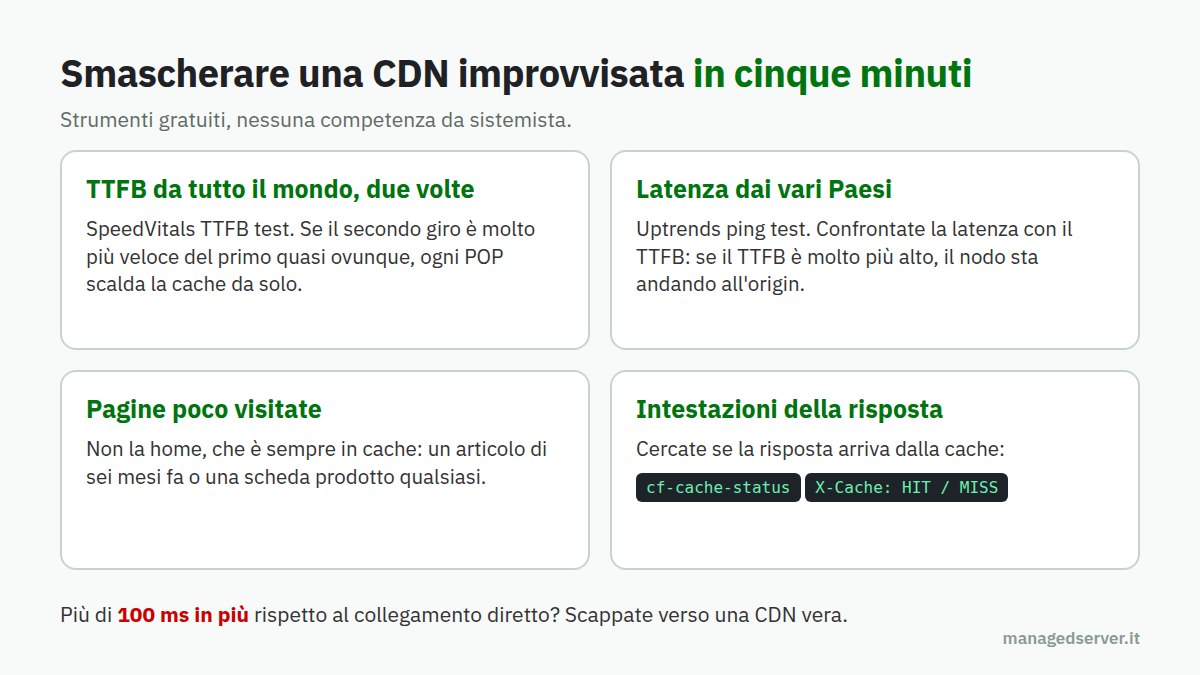
The good news is that unmasking a rogue CDN doesn't require system administrator skills. All it takes is two free tools and five minutes.
Whenever you read about proprietary CDNs, edge nodes, global networks, and guaranteed performance around the world, use SpeedVitals’ TTFB test , which measures your site’s response time from dozens of locations around the world, and Uptrends’ ping test , which measures latency from various countries.
- Take the test twice in a row. If the second round is much faster than the first in almost all locations, each node has its own cache and must warm it up itself: your real visitors, who don't make two rounds, will almost always take the first.
- Look at the locations near the origin. If Paris, Madrid, Amsterdam, or Warsaw have a TTFB that is more than 100 milliseconds higher than what you would get by connecting directly to the server, the CDN is wasting your time instead of gaining it.
- Try pages other than the home page. The home page is always cached everywhere. Try an article from six months ago or a rarely visited product page: that's where the truth lies.
- Read the response headers. Serious CDNs declare whether the response comes from cache, with headers like
cf-cache-status(we have explained the status codes) or a headerX-Cachewith HIT or MISS. If you see MISS almost anywhere, you already know everything.
If the numbers are negative and you see differences greater than 100 milliseconds, there's no need to think too hard: run to real CDNs, like Cloudflare, and leave the junk improvised by the clowns of the moment to whoever wants to be a guinea pig.
And if a CDN isn't needed, what is?
For the vast majority of Italian and European websites, the answer isn't an edge network, but a well-designed origin. A server centrally located for the public, with dedicated and measured resources, and a carefully configured web cache, with a high HIT ratio, correct invalidations, and custom content management. This keeps TTFB low for everyone, without ten caches to warm up, without old pages forgotten in some node, and without any clowns in the way.
However, when your audience is truly international, or you need DDoS protection, bot filters, and capabilities that a single server can't offer, the sensible choice is a real CDN, configured by someone who knows what they're doing. It's no coincidence that we also offer consulting on Cloudflare : the technology already exists, it's mature, and it's accessible even on free plans. Reinventing it poorly makes no sense.
Conclusions
Artificial intelligence has made basic skills accessible to everyone. This is a wonderful thing, and it has allowed many professionals to learn and grow. But it has also given many clowns the illusion of being able to build in an afternoon what others have built over twenty years, with thousands of engineers and enormous investments.
A CDN isn't a collection of reverse proxies scattered across Europe with a DNS that responds based on location. It's a distributed system that only works if caches are consistently warmed up, shared, and invalidated, if failed nodes exit the network on their own, and if someone checks every day to make sure all this is actually happening.
If someone offers you their proprietary CDN, don't ask how many points there are on the map. Ask them how caches are shared between nodes, what happens in the event of a MISS, how the cache is invalidated network-wide, and how long it takes. Then open SpeedVitals and measure. If the answers are vague and the numbers are bad, you've just met another clown. Say thank you, smile, and move on.

