
Table of contents of the article:
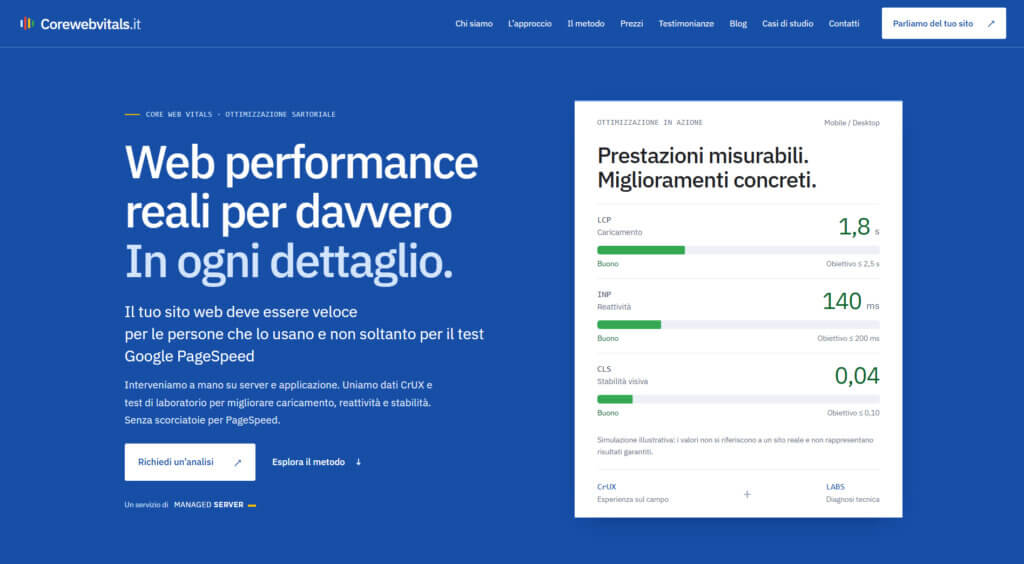
Corewebvitals.it is born, the Managed Server project dedicated to the browsing experience.
For over twenty years, Managed Server Srl has been working on the performance of systems hosting websites, publishing platforms, and e-commerce sites. With Corewebvitals.it, we're opening a new chapter: a space dedicated to the analysis and optimization of Core Web Vitals and, more generally, the quality of the experience a site offers its visitors.
Corewebvitals.it was born as a complementary project to our Managed Server activities . Our infrastructure work remains a fundamental part of performance, but the speed perceived by users depends on many elements that come into play after the server response: code, images, fonts, scripts, ads, interface, and the way the browser composes the page.
That's why we've decided to make the skills we've long applied to web performance projects explicit and accessible. Corewebvitals.it allows us to focus on the entire process, from the initial request to viewing and interacting with the page.
Performance doesn't end when the server responds
A fast server can reduce the time it takes to receive the first data, but it can't solve every navigation problem on its own. A page might start loading quickly and still take a long time to display the main content. Elements might shift as it loads, making it difficult to read or select a product. Or it might appear complete, but respond slowly to taps and clicks.
Core Web Vitals help us observe some essential dimensions of this experience: the loading of the main content, responsiveness to interactions, and visual stability. They aren't a comprehensive description of every aspect of a site, but they are concrete indicators for identifying problems people may encounter while browsing.
The starting point, therefore, isn't chasing a single number. It's understanding what's really slowing down the site and what interventions can improve the actual experience . Sometimes the bottleneck is related to the infrastructure or page generation; other times it depends on JavaScript, images, fonts, layout, or third-party integrations. Often, it's a combination of multiple factors that determines the outcome.
From Data to Decisions: Measuring with Context
Evaluating performance requires a variety of measurements, interpreted correctly. Data collected from users describes what happens during real visits, across different devices, connections, and conditions. Lab tests, on the other hand, help reproduce controlled scenarios and investigate the technical causes of problems.
The two perspectives answer different questions. Real-world data shows how the site performs for the public; lab tests help verify a change or understand a particular loading path. Using only a synthetic test can leave out what actually happens to visitors. Considering only an aggregate value, without delving into the pages and components involved, can make it difficult to know where to start.
The Corewebvitals.it method begins with a review of available data and continues with an analysis of the pages and resources that impact the experience. The goal is to transform the diagnosis into verifiable interventions, defining understandable priorities and evaluating the effects of the changes. Each optimization must have a technical rationale and an observable result , not simply be a score adjustment.
A job that involves server, application and browser
Managed Server's expertise in Linux hosting and systems engineering is an important foundation for the project. We understand the role of infrastructure, databases, caching systems, and software configurations in ensuring responsiveness. Corewebvitals.it extends this focus to the browser and the elements that determine the actual behavior of the page.
A project may require interventions on multiple levels: from reducing response times to resource management, from image optimization to script control, to element stability during loading. Priorities vary depending on the site, its architecture, and the features it offers. A publishing portal, an online store, and a web application all have different needs and require specific analyses.
For this reason, we don't consider Core Web Vitals to be a problem that can be solved with a one-size-fits-all solution. Plugins and automated tools can be useful in certain contexts, but they're no substitute for understanding the site and its constraints. A successful outcome stems from a balance between user needs, application functionality, and infrastructure capabilities.
A blog to share methods and knowledge
The project is accompanied by a blog dedicated to guides, analysis, and insights . We want to use it to explain how to read metrics, identify problems, and evaluate solutions, with useful content for those who manage, develop, or monitor site performance.
We'll discuss measurement, real-world experience, analysis tools, and technical interventions. We'll also address the most common simplifications: the idea that getting a high score on a test is enough, that a single plugin can solve every problem, or that performance depends solely on hosting. The aim is to offer practical guidance, while clearly highlighting the connection between data, causes, and decisions.
The blog will grow over time, reflecting the evolution of web tools and technologies. It will be a space for discussion and dissemination, designed to make topics more accessible, often addressed in a fragmented manner or presented through overly simple promises.
An extension of our work
Corewebvitals.it isn't a separate project from our Managed Server experience: it's a specialized extension of it. We continue to work on server-side performance and, through this new space, we're broadening our focus to include other factors that impact navigation.
We believe that performance should be evaluated from the perspective of those who use the site , using a method that combines technical expertise, measurement, and analysis. It's not about chasing a green screen, but about making pages faster, more stable, and more responsive in the conditions in which people visit them.
To learn more about the project, visit the About Us page , or follow updates and new guides on the Corewebvitals.it blog.

