
Table of contents of the article:
Every now and then, someone decides to build their own CDN. In theory, it's a great idea: distributed nodes, content close to users, shorter response times, and no dependency on large providers. In practice, a CDN is one of the most difficult infrastructure projects to execute well, because everything depends on a few milliseconds, and one weak link can lose them all, and then some.
This is the case with Iweblab's CDN, Peppe's brainchild. The initial idea is legitimate, but the implementation is much less so: we measured, compared, and dug into the DNS, and the result is that the bottleneck isn't the network, not the server, but the very mechanism by which the CDN decides where to send visitors . What was supposed to save time is precisely where time is wasted.
We know that Peppe isn't happy with articles like this, because they call into question his technological choices. But here, there are no opinions to be taken on trust: there are measurements, commands, and numbers that anyone can do in five minutes. And rightly so, because when a solution is advertised to customers as faster, speed is measured.
The test: same instrument, same measuring points
We used a common multi-location HTTP testing service, which queries a site from dozens of cities and breaks the total time down into three parts:
- Resolve time: the time to resolve the domain name to an IP address, i.e. the DNS response;
- Connection time: the time to open the connection to the server, which depends mainly on the network distance;
- Download time: the time it takes the server to process the request and send the response.
On one side is managedserver.it, served from a single origin in Italy, without a CDN in front of the HTML. On the other is iweblab.sm, the site of the CDN vendor, which obviously uses its own CDN.
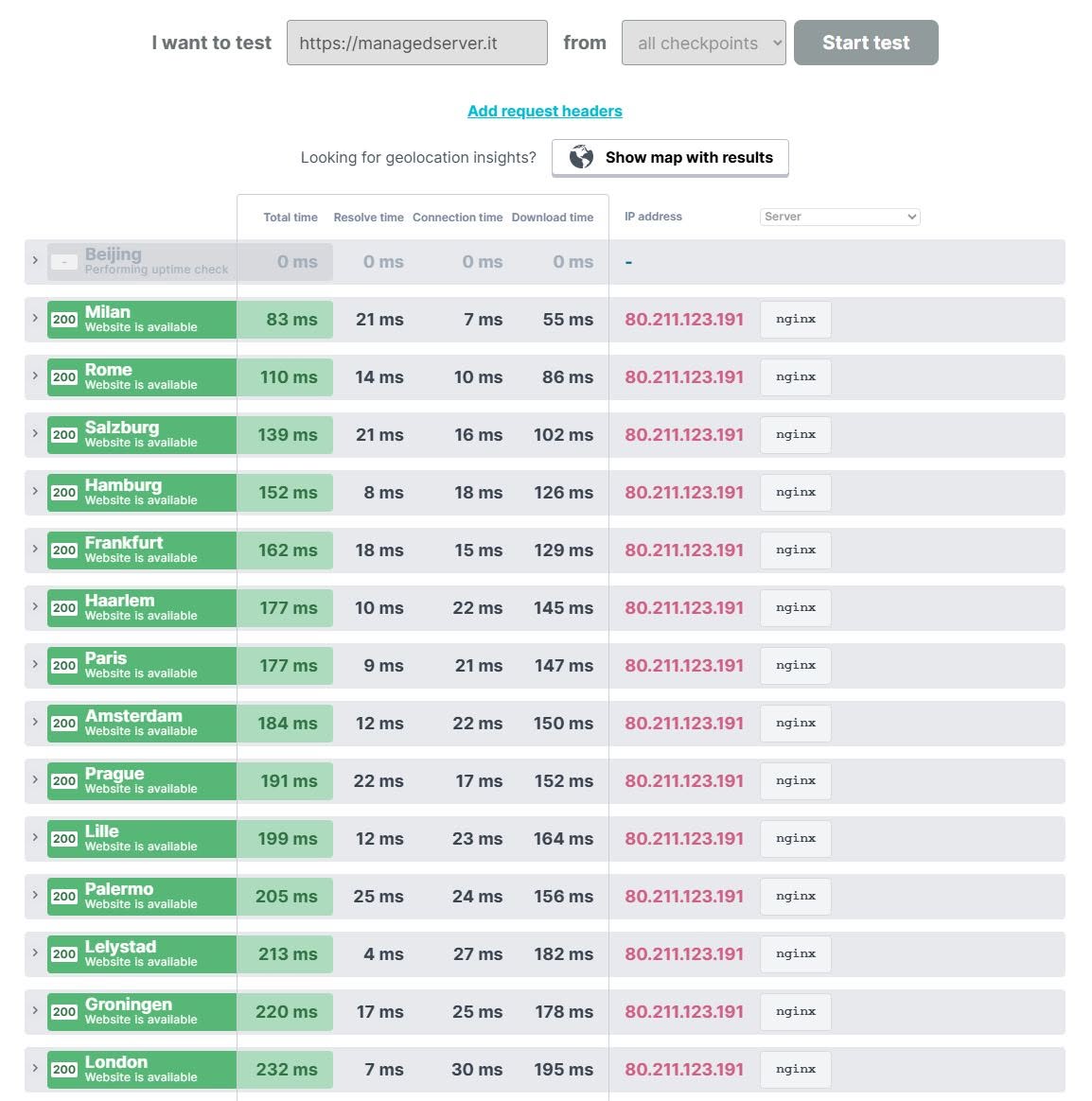
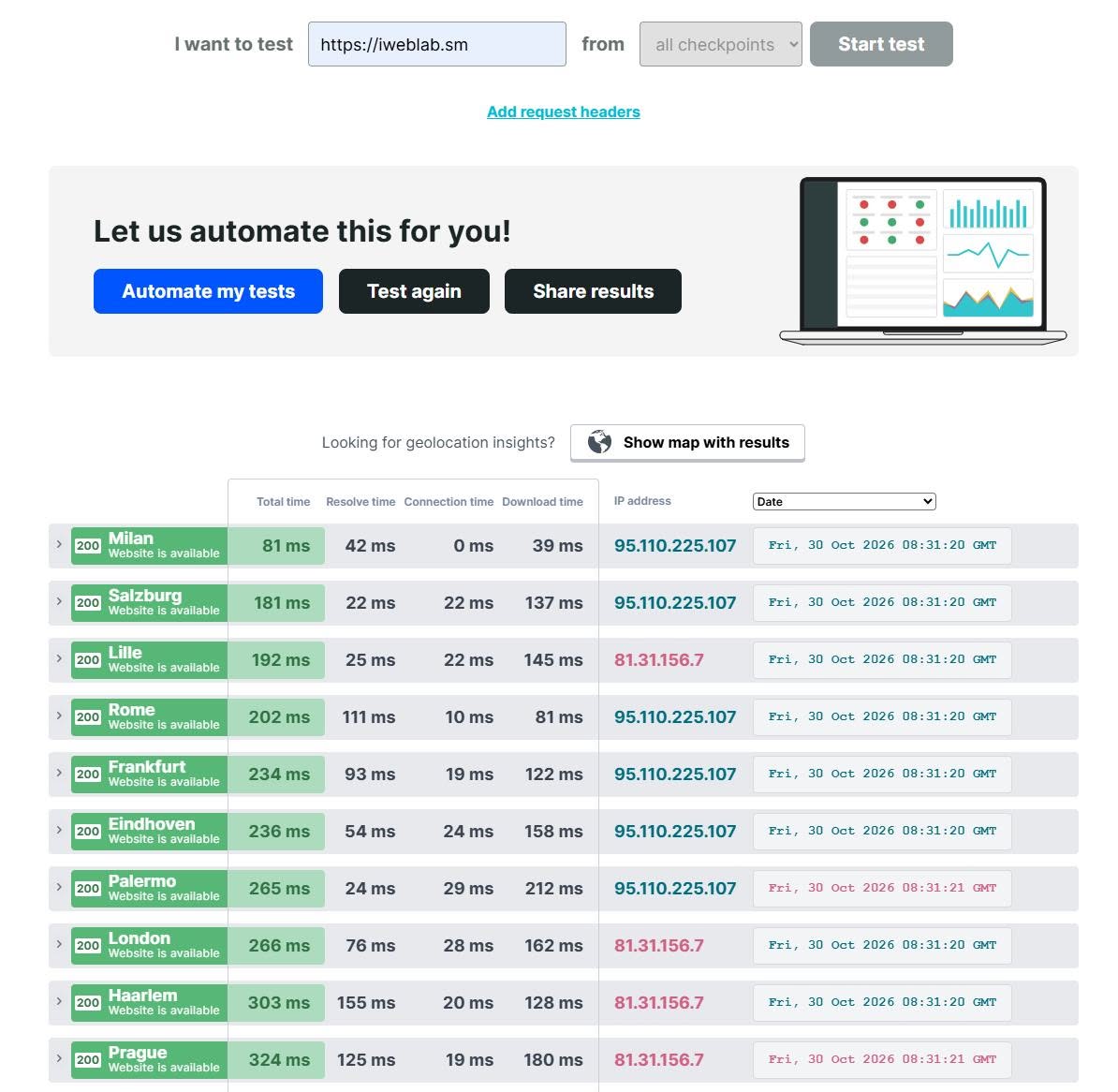
The iweblab.sm test was performed on October 30, 2026, at 08:31 AM GMT. It's worth pausing for a moment at the IP address column, because it already tells half the story: some cities receive 95.110.225.107 , others 81.31.156.7 . This is the unmistakable sign of GeoDNS : the DNS responds with a different address depending on where the query comes from. On managedserver.it, however, all cities receive the same address, 80.211.123.191.
The numbers, city by city
We compared the nine cities present in both tests (MS stands for managedserver.it).
| City | Total MS | Total Iweblab | MS DNS | DNS Iweblab | MS Connection | Iweblab Connection |
|---|---|---|---|---|---|---|
| Milan | 83 ms | 81 ms | 21 ms | 42 ms | 7 ms | 0 ms |
| Salzburg | 139 ms | 181 ms | 21 ms | 22 ms | 16 ms | 22 ms |
| Lille | 199 ms | 192 ms | 12 ms | 25 ms | 23 ms | 22 ms |
| Rome | 110 ms | 202 ms | 14 ms | 111 ms | 10 ms | 10 ms |
| Frankfurt | 162 ms | 234 ms | 18 ms | 93 ms | 15 ms | 19 ms |
| Palermo | 205 ms | 265 ms | 25 ms | 24 ms | 24 ms | 29 ms |
| London | 232 ms | 266 ms | 7 ms | 76 ms | 30 ms | 28 ms |
| Haarlem | 177 ms | 303 ms | 10 ms | 155 ms | 22 ms | 20 ms |
| Prague | 191 ms | 324 ms | 22 ms | 125 ms | 17 ms | 19 ms |
| Media | 166 ms | 228 ms | 17 ms | 75 ms | 18 ms | 19 ms |
Three things catch the eye.
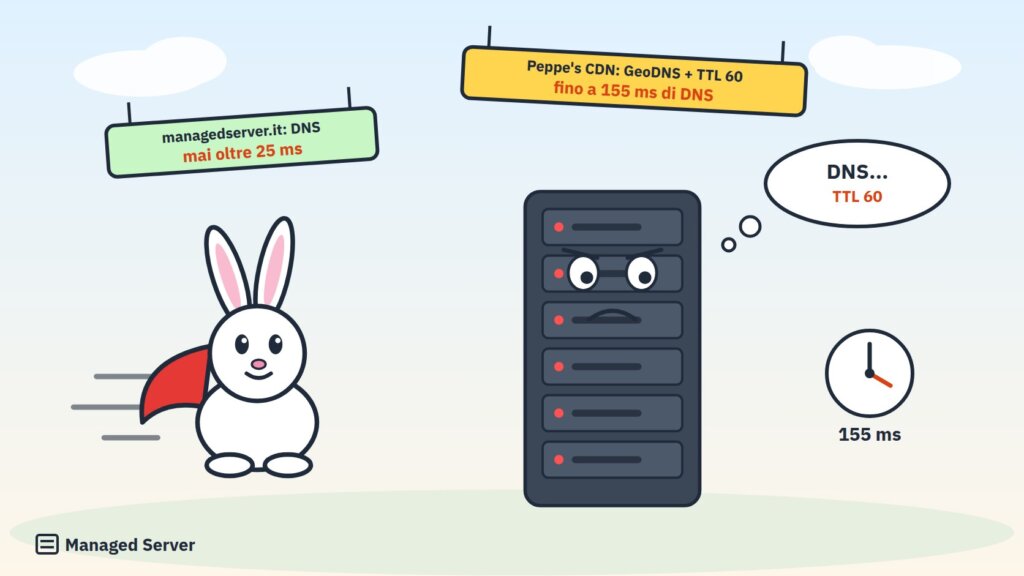
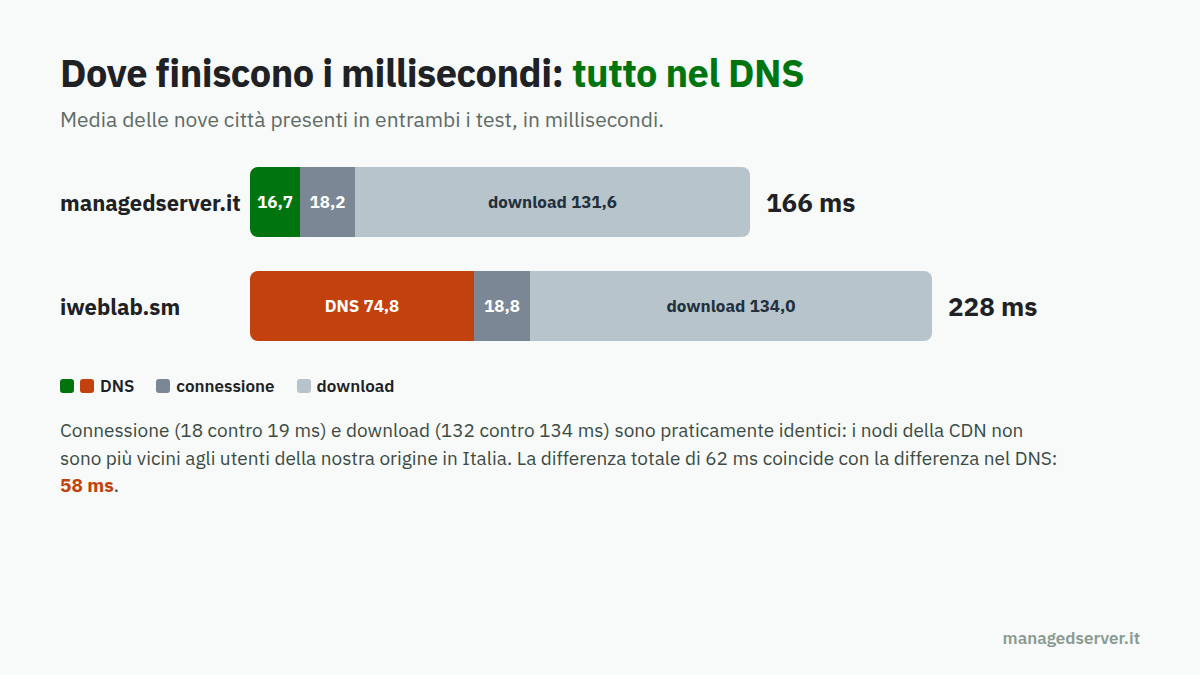
The first: DNS. On managedserver.it, the resolution never exceeds 25 ms, with an average of 17. On Iweblab's CDN, the average is 75 ms, five out of nine cities are above 75 ms, and Haarlem reaches 155 ms . In Haarlem and Rome, the DNS response alone accounts for more than half of the entire response loading time. The visitor hasn't even exchanged a single byte with the server and has already lost a sixth of a second.
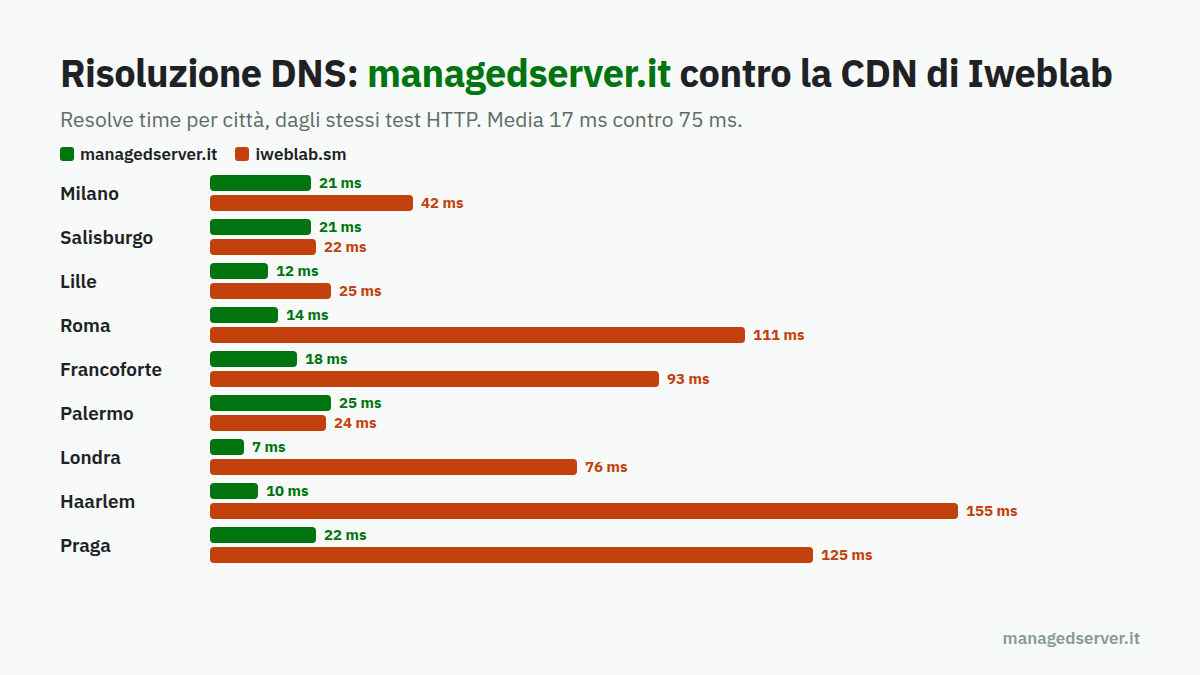
Second: the connection times are identical. 18 ms on average versus 19. And this is where the CDN proves itself wrong. If London, Haarlem, Lille, and Prague, which receive the address 81.31.156.7, were served by a nearby node, the connection from those cities should last a few milliseconds. Instead, London takes 28 ms to connect to the CDN and 30 ms to connect to our server in Lombardy: the network distance is the same. Geolocation databases place both CDN addresses in Italy, one on Aruba's network and the other on a Host SpA network in Piedmont. Two nodes, both in Italy, just a few hundred kilometers apart. GeoDNS chooses which of the two to give to a user in London, but the London user is still over a thousand kilometers from the content.
Third: even the download times are the same , 132 ms on average for us and 134 for them. It's not a perfect comparison, because the pages are different in size and processing, but it confirms that the CDN doesn't bring any measurable advantage in content delivery.
To summarize: the 62 ms difference between the two total averages coincides almost to the millisecond with the 58 ms difference in DNS resolution . Everything the CDN adds is waiting time in front of the DNS. Everything it should remove—distance—it doesn't.
Inside CDN DNS: Why It's So Slow
The screenshots show the symptom; to find the cause, all you need is a terminal and the command digOn November 1, 2026, we queried Iweblab's DNS servers from a connection in Italy.
The domain iweblab.sm is delegated to Cloudflare's nameservers, which respond in 14-25 ms, exactly like those of managedserver.it. So far, no problems. The problem arises one step later: www.iweblab.sm is a CNAME towards edge.iweblab.net, the name of the CDN, and the domain iweblab.net is managed by four of its own nameservers:
| Name servers | Where it is | Response time from Italy |
|---|---|---|
| ns1.iweblab.it | Italy, Host SpA network | 21-29 ms |
| ns2.iweblab.net | Germany, Hetzner Falkenstein | 36-40 ms |
| ns4.icloud.sm | Finland, Hetzner Helsinki | 62-65 ms |
| ns3.iweblab.it | California, Digital Ocean | 157-168 ms |
Yes, you read that right: one of the four nameservers of a CDN designed for Europe is in California . A resolver that doesn't yet know the response times of the four servers chooses one more or less randomly, and one out of four times it ends up on the other side of the ocean. Furthermore, during our tests, a query to ns1 timed out, forcing the resolver to fall back to another server.
Making matters worse is the 60-second TTL on CDN records. The TTL is the time a resolver can cache a response: with 60 seconds, the response continually times out, and most visitors don't find it ready, so they pay for the entire resolution chain. GeoDNS requires short TTLs to move traffic quickly, but this is a costly choice with every single resolution, and here, it's paid for with slow and distant nameservers.
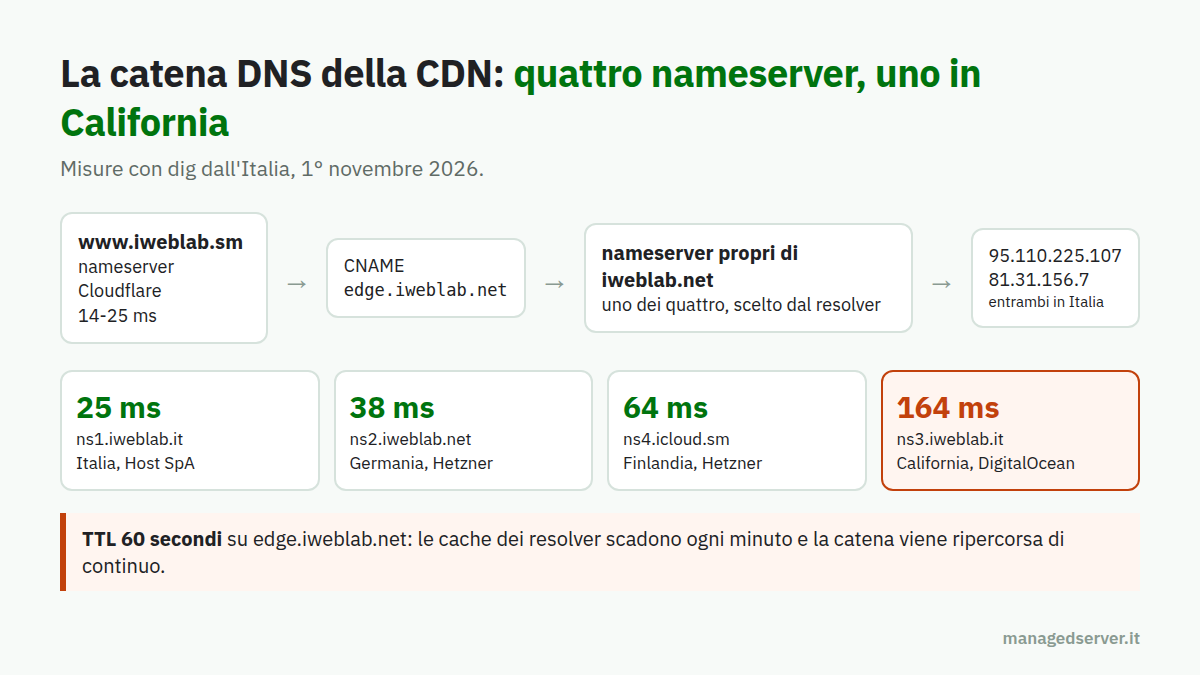
The math, at this point, adds up: a chain with one extra hop, a TTL that flushes caches every minute, and one nameserver out of four at over 150 ms. The 93, 111, 125, and 155 ms measured in Frankfurt, Rome, Prague, and Haarlem are exactly what you'd expect from such an architecture.
GeoDNS and Anycast: The Difference That Makes the Difference
To understand why the choice of GeoDNS is the Achilles heel of this CDN, we need to understand how the two techniques with which a CDN can send each user to the closest node work.
GeoDNS
With GeoDNS, each node has a different IP address. When a DNS request arrives, the nameserver looks at the originating location, consults a geolocation database, and responds with the IP address of the node it believes is closest. It has three structural weaknesses:
- DNS becomes part of the critical path: The decision requires a tailored DNS response, which cannot be cached for long, hence short TTLs and multiple full lookups.
- The nameserver sees the resolver, not the userThose who use Google, Cloudflare, or their own DNS provider are localized based on the resolver, which may be located in another country. The EDNS Client Subnet extension mitigates this problem, but not all resolvers send it: Cloudflare's 1.1.1.1, for example, deliberately doesn't.
- Geolocation databases are wrong, especially on corporate, mobile and large cloud addresses.
Anycast
With Anycast, the same IP address is announced via BGP by all nodes simultaneously. The DNS always responds with the same IP, with long TTLs and working caches, and Internet routing takes care of bringing the user to the closest node: packets follow the shortest path to the closest announcement. There's no geolocation to guess, no tailored DNS responses, and in the event of a node failure, simply withdrawing the announcement is enough for traffic to move within seconds. This is why Cloudflare, Fastly, Google, and all the top-tier CDNs use Anycast, both for nodes and DNS.
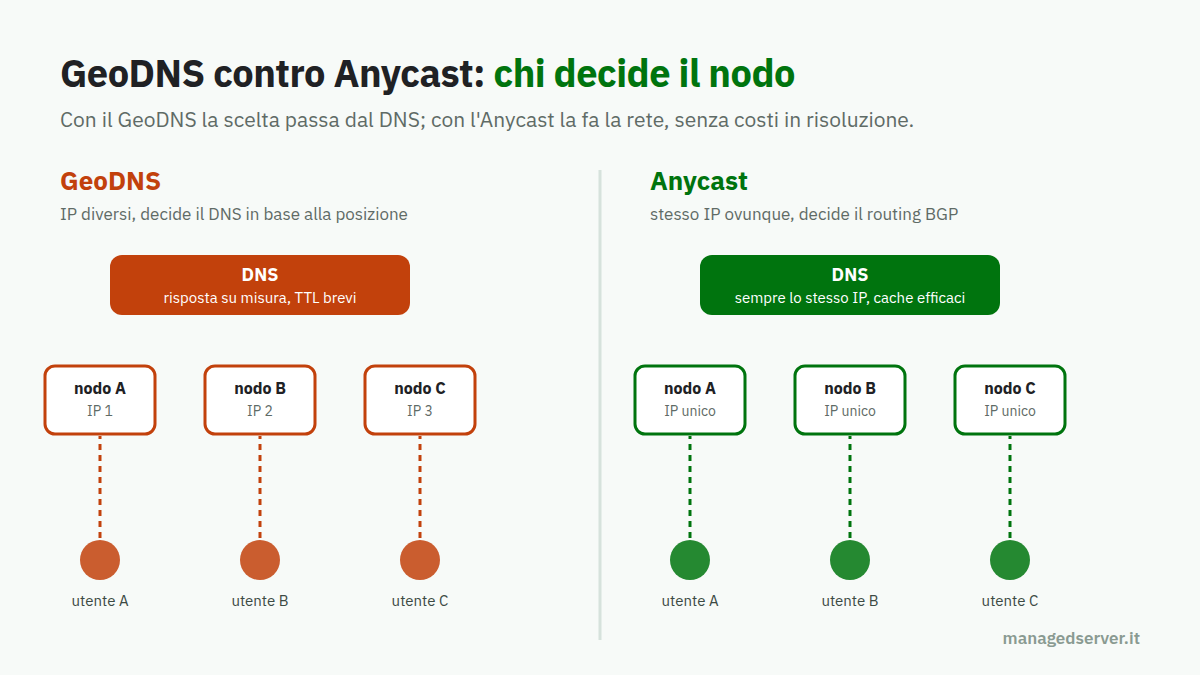
Anycast comes with a price to pay, however: it requires its own Autonomous System , its own IP address space (at least one /24 IPv4 and one /48 IPv6), transit and peering connectivity in each location, and the ability to manage BGP sessions across multiple points of presence. And this is where we get to the real point.
The problem of scale
A CDN makes sense when users are far from the origin and the nodes are close to them. Iweblab's CDN has two nodes, both in Italy, serving sites with a largely Italian audience. For an Italian user, a good server in Italy is already the closest possible node. For a user in London, two Italian nodes instead of one make no difference, as demonstrated by the identical connection times.
The result is a CDN that has all the costs of CDNs—complexity, DNS chains, short TTLs, and the distributed cache to invalidate—without their only real benefit: proximity. A two-node CDN isn't a CDN at all: it's an origin with an extra address and slower DNS.
To build something truly useful, scale would be needed: dozens of points of presence in Europe and around the world, Anycast, peering agreements, a global DNS. It's a sensible investment for those serving massive, distributed traffic, and it's no coincidence that the CDN market is dominated by a few operators with gigantic networks. For everyone else, there are more effective and cost-effective options: an optimized origin in Italy with a good HTML cache, which is what we do, or a true Anycast CDN in front of the origin for truly international audiences.
What would we have done?
Since it's easy to criticize, here's what we would change, in order of cost:
- Remove the nameserver in California, or at least move the four nameservers to Europe: this is the simplest intervention and by itself eliminates the worst peaks.
- Entrust the CDN zone to an Anycast DNSIweblab already uses Cloudflare for iweblab.sm, so they know exactly how it's done.
- Raise the TTL a few minutes: with two nodes both in Italy, the flexibility of 60 seconds is not worth the price paid for each resolution.
- Asking yourself whether CDN is really usefulWith two Italian nodes and an Italian audience, the honest answer is no: better to have a single, well-optimized origin with a high-hit ratio HTML cache.
Good intentions, bad measures
The road to hell, as we know, is paved with good intentions. Building a CDN is a fascinating technical challenge, and let's be clear: if presented for the university Networks exam, with GeoDNS, multiple nodes, and redundant nameservers across four providers, Peppe's CDN would probably have gotten an A+.
But the market, the real one, doesn't grade a project: it measures milliseconds. And milliseconds tell us that a user in Haarlem waits 155 ms just to find out which server to connect to, before connecting to Italy anyway. With just one server and no CDN in front of the HTML, we never exceed 25 ms of DNS resolution in that test.
The commands are public, the testing tools are free, and the results are reproducible by anyone. If anyone has different measurements, please post them: we'll be the first to read them carefully.
If you want to understand where your site's milliseconds are really being wasted—between DNS, network, servers, and cache— let's talk : it's our daily work. For more in-depth information, we've also written about why Anycast routing is the foundation of every CDN and why the hit ratio matters in a cache.

