













Support
Redis ®

Redis® system support for businesses: design, tuning, and 24/7 management with guaranteed SLAs.
On premise
and in the cloud:
Years of experience
15 +
Managed instances
10000 +
Continuous assistance
24 H
Intervention time
1 Now
More than 5000 companies have used our services

Need support on Redis®?

A single technical partner for the entire Redis lifecycle

Redis is the world's most widely used open-source in-memory database, serving as a cache, session store, message queue, and ranking, counter, and rate-limiting engine. It responds in fractions of a millisecond because it operates entirely in RAM, which is precisely what makes it vulnerable: poorly sized memory, an incorrect eviction policy, or unsuitable persistence for the data can lead to lost keys, unexpected crashes, or instances exposed to the internet. Our team supports companies at every stage: architecture analysis and design, installation and migration, replication, Sentinel, and Cluster configuration, monitoring, operational support, and internal staff training. The goal is simple: to maximize performance from Redis, measured in latency, stability, and infrastructure costs.
Marco Marcoaldi - Founder Managed Server Srl
Marco Marcoaldi
Founder & Systems Engineer Managed Server
cdn-cache-software-e-cache

Why choose Redis®

Data in memory, responses in fractions of a millisecond

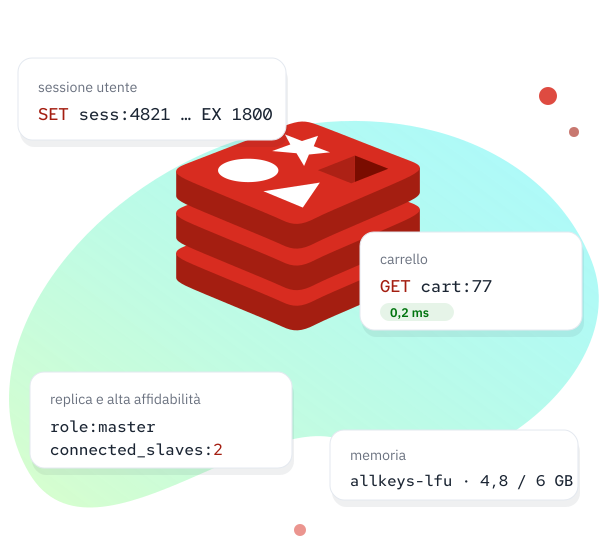
Redis stores data in RAM and serves it in fractions of a millisecond , freeing the relational database from repeated reads, sessions, and counters. The result is a faster application and increased load capacity with the same infrastructure.

It's not just a cache: strings, hashes, lists, sorted sets, streams, and probabilistic structures allow you to easily solve sessions, carts, work queues, leaderboards, rate limiting, and distributed locking , with atomic commands and without writing complex logic.

For the company, this translates to faster pages , better Core Web Vitals , less load on the database , and lower infrastructure costs , with the ability to grow via replication and clusters as traffic increases.

Our job is to transform this potential into measurable results, with a configuration designed for your load and continuous monitoring over time.

Implementation on major CMS and e-commerce platforms

Redis tailored for WordPress, WooCommerce, Magento, and other CMS

Each platform uses Redis differently: object cache on WordPress and WooCommerce, cache and sessions on Magento, application cache, cart and lock on Shopware, cache on PrestaShop and Drupal. That's why we don't use generic configurations: we separate databases or instances by data type and choose the appropriate persistence and eviction for each.

A cache can be emptied without harm, sessions and carts cannot: mixing them in the same instance with an aggressive eviction policy means customers losing their carts or getting disconnected at the wrong time.

The result is a site that handles high traffic volumes with a streamlined database, reduced response times, and a seamless shopping experience, even during peak periods like sales and Black Friday.

Varnish installation on Open Source CMS
PHP Framework Zend Laravel Yii CakePHP - Ruby Technologies - Python - Go - Java - Net

Redis implementation on custom applications

Integration with enterprise application frameworks and stacks

We integrate Redis into proprietary applications developed with major PHP frameworks, such as Laravel, Symfony, CodeIgniter, Laminas (Zend Framework) and CakePHP , and on different stacks: Python and Django , Ruby on Rails , Java and Spring , Node.js , Go and .NET.

We work with your team to design the key scheme , deadlines, invalidation strategies, and use the right structures: work queues with lists or streams , pub/sub for real-time notifications, distributed locking , and rate limiting with atomic commands or scripts.

We also check the client side: connection pool , timeout, reconnection and failover management, because an application that doesn't know how to react to the loss of a node undermines any high-availability architecture.

Advanced configuration and custom tuning

Advanced configuration, monitoring and customization

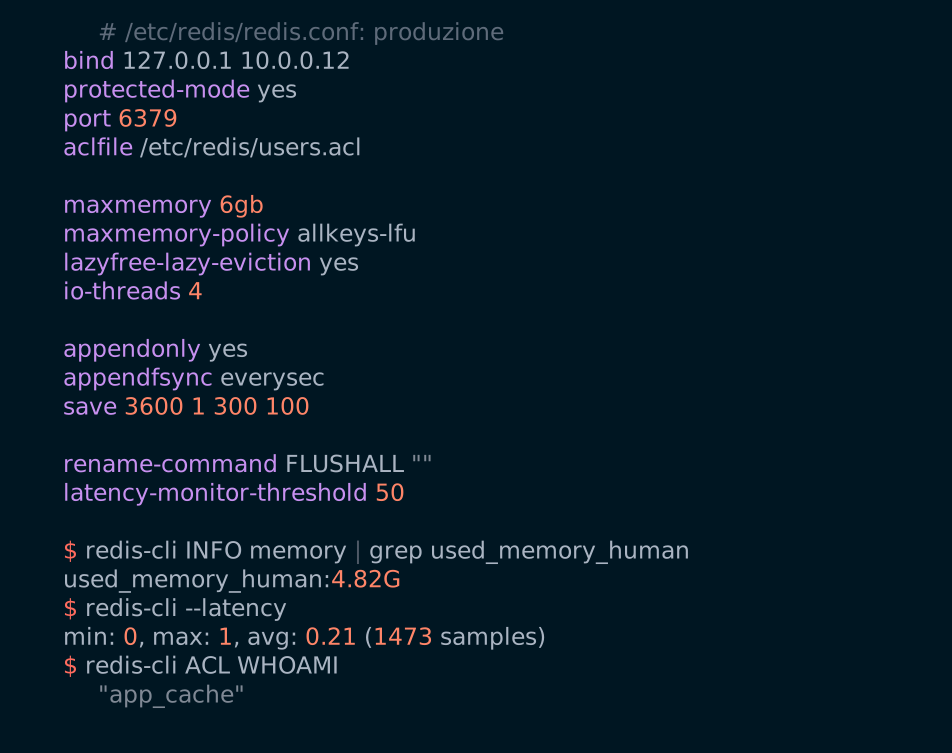
We design the Redis configuration starting from the data: we analyze the number and size of keys, the most used commands and the memory usage, and we define maxmemory and the most suitable eviction policy , for example LRU or LFU for caches and no eviction for data that should not disappear.

We choose persistence based on the data value: RDB snapshots , AOF with fsync every second, or no persistence for pure caches. We configure io-threads , client limits, timeouts, and kernel parameters that Redis requires, such as memory overcommitment and transparent huge pages disabled.

Each installation is supported by continuous monitoring : memory usage and fragmentation, hit ratio, evicted keys, latency, slowlog, replication and save status. Anomalies are identified before they become a problem for users.

The result is a predictable, documented Redis that is integrated into your application ecosystem.

Redis Configuration Support
Server Technology Analysis

Diagnosis and troubleshooting

Rapid interventions on latencies, memory and anomalous behaviors

OOM errors, disappearing keys, latency spikes, instances crashing while saving, replicas constantly resyncing, or connections exhausted: these are issues that directly impact revenue and reputation, and they need to be resolved quickly.

Our method is structured: analyzing INFO, slowlog, latency monitor, and logs , searching for big keys and hot keys , blocking commands like KEYS or slow scripts, identifying the cause, and then implementing a permanent fix . When necessary, we immediately apply a temporary solution to restore service and complete the resolution at a later time.

Critical incidents are handled with priority and within the timeframes set by the SLA , by systems engineers who have in-depth knowledge of Redis.

Safety and Incident Management

Structured procedures and transparent communication

Redis is designed to run on trusted networks: an instance exposed to the Internet without authentication is detected and compromised within minutes. For this reason, we apply configuration hardening : listening only on private interfaces, protected mode, ACL users with only necessary permissions, disabled dangerous commands, and TLS when traffic crosses untrusted networks.

We monitor the project's security bulletins and activate our incident management procedures when vulnerabilities are identified . This happened with RediShell (CVE-2025-49844) , a critical flaw in the Lua engine fixed in versions 6.2.20, 7.2.11, 7.4.6, 8.0.4, and 8.2.2: where the update wasn't immediate, the recommended mitigation was to block the EVAL and EVALSHA commands via ACLs.

We assess the impact on your installation, apply mitigations, and provide clear and timely information on the nature of the problem, risks, and status of the intervention.

L3 and L7 DDOS Protection
Workflow

Updates and life cycle

Complete update management, without production risks

We keep Redis up to date with security patches , fixes, and new releases, scheduling each update to minimize service impact. With replication or Sentinel, updates occur one node at a time , without disrupting the application.

Before each upgrade, we check the compatibility of your configuration, modules, and clients, prepare a rollback plan , and manage major version transitions, such as from Redis 6 or 7 to Redis 8.

We also help you with licensing choices: Redis 8 is also distributed under the AGPLv3 license , while Valkey , the fork of Redis 7.2 supported by the Linux Foundation, remains under the BSD license. We manage both and, if necessary, migrate from one to the other.

Your team is free to focus on your business, knowing that Redis is always up to date, secure, and supported.

Consulting and training

Transferring skills to your team

Redis is easy to install, but not easy to use: choosing the right data structure, consistently naming keys, setting expirations, and avoiding commands that crash the instance can make the difference between a fast system and a fragile one. We answer your team's questions about data modeling, architecture, and best practices , providing clear and verified answers, within the timeframes set by the SLA.

Upon request, we organize training sessions for developers and system administrators and provide documentation of the configuration created, so that the know-how remains within the company.

documentation support
Cloud logos - AWS - Microsoft Azure - Hetzner - Google Cloud - Alibaba Cloud - OVH Cloud - IBM Cloud

Operational on premise and on major cloud providers.

Your infrastructure, wherever it is

We run Redis on physical servers in your data center, on private infrastructure, in containers, and on major public clouds. We operate daily on AWS, Microsoft Azure, Google Cloud, Alibaba Cloud, IBM Cloud, Hetzner, OVHcloud, Linode, and DigitalOcean , as well as managed services like Amazon ElastiCache.

Whether you're considering a migration to the cloud , between providers, or from a managed service to your own installation, we design the architecture and move your data with replication or snapshots to maintain performance and service continuity throughout the journey.

You can open a ticket at any time: our team of Linux system administrators intervene remotely, wherever your infrastructure is located.

GDPR compliant

Data processed in the European Union, in compliance with Regulation (EU) 2016/679

We are an Italian company and operate in full compliance with the GDPR . Your infrastructure information, tickets, and support communications are treated with strict security and confidentiality criteria.

Data is stored exclusively within the European Union and deleted within 30 days of completion of the activity . Our procedures follow industry best practices regarding data protection and retention, to offer you full regulatory compliance.

GDPR compliant

Measurable goals, enterprise technologies.

FAQ

Redis is an open-source database that stores data in memory and responds in sub-milliseconds. It's primarily used as a cache for relational databases, as a session store, and as a message queue, but it also offers advanced data structures such as hashes, lists, sorted sets, streams, and search indexes.

It can save data to disk with RDB snapshots or the AOF registry, replicate it to other nodes, and distribute it across multiple servers with Redis Cluster. It powers most modern web applications, from e-commerce to social networks.

Redis takes the most repetitive work off the relational database and runs it in memory. This means:

Faster applications, with benefits on user experience, Core Web Vitals and positioning.
Less load on the database, who can devote himself to the operations that really matter.
Lower infrastructure costs, because fewer resources are needed for the same traffic.
Ready-to-use functions for sessions, queues, counters, leaderboards, and rate limiting.

We cover the entire lifecycle: architecture analysis and design, installation and configuration, memory sizing, persistence, replication, Sentinel and Cluster, integration with CMS and applications, migration from other solutions or between Redis and Valkey.

In production, we offer continuous monitoring, performance analysis, updates, security audits, SLA-compliant troubleshooting, and internal staff training. Services are available as both a one-time intervention and an ongoing support agreement.

Redis is often installed and forgotten until something breaks. Expert support is especially helpful if:

Memory grows out of control or OOM errors appear.
Latency has sudden spikes, perhaps in correspondence with the saves.
Sessions and carts get lost or users are logged out.
Redis is a single point of failure and you want replication and automatic failover.
You don't know if the instance is exposed or if it is updated against known vulnerabilities.

An initial analysis allows us to estimate the margin for improvement before any investment.

In most cases, yes. On WordPress and WooCommerce, Redis acts as a persistent object cache and drastically reduces database queries; on Magento and Shopware, it manages cache and sessions and is officially recommended for production; on PrestaShop and Drupal, it reduces the application cache.

However, it must be configured properly: cache and sessions require different persistence and eviction, and a poorly configured plugin or module can make things worse instead of better. We take care of the integration and verification of the results.

Yes. There are mature Redis clients for all popular languages, and major frameworks support it natively for caches, sessions, and work queues.

We work with your team to define the key scheme, expirations, the most suitable data structures, and client-side error handling, including connection pools, timeouts, and failover response. This ensures Redis remains fast even as your data grows and your application evolves.

After going into production, we continue to monitor and optimize the configuration as the load changes.

Redis runs on Linux, on physical servers, virtual machines, containers, or cloud instances. The main requirement is memory: data resides in RAM, so it must be sized to the actual volume, leaving room for fragmentation and disk backups, which temporarily duplicate modified pages.

Some system adjustments are also required, such as enabling memory overcommitment and disabling transparent huge pages, as well as a private network between the application and Redis. If these skills aren't available in-house, we can handle the entire project, from sizing to day-to-day management.

In 2024, Redis changed its license, and the Linux Foundation launched Valkey, a fork of Redis 7.2 under the BSD license, supported by major cloud providers. With Redis 8, the original project is once again available under the AGPLv3 open source license and integrates features such as JSON, search, and time series.

For most applications, the two are compatible at the protocol and command levels. The choice depends on your licensing, required features, and your provider's managed services: we can help you evaluate and, if necessary, migrate from one to the other.

Yes. Managed Server is an Italian company and provides its services in compliance with the General Data Protection Regulation (EU Regulation 2016/679). Data relating to your infrastructure and support requests are processed within the European Union and deleted within 30 days of completion of the services.

For security, we limit listening to private networks, enable ACL users with only the necessary permissions, disable dangerous commands, encrypt traffic with TLS where necessary, and keep Redis updated against known vulnerabilities.

For reliability, we configure one or more replicas and Redis Sentinel, which automatically promotes a replica if the primary node fails, or Redis Cluster when data or load exceeds a single server. Failover and recovery procedures are tested, not just documented.

Disclaimer and Legal Notices: Redis® and Linux® are registered trademarks. In particular, Redis® is a registered trademark of Redis Ltd., and all rights therein are reserved by Redis Ltd. Valkey is a project of the Linux Foundation. Linux® is a registered trademark of Linus Torvalds in the United States and other countries. MANAGED SERVER SRL is not affiliated with, sponsored by, or otherwise associated with Redis Ltd., the Linux Foundation, or Linus Torvalds, and does not represent any of these entities in any way. All rights to the trademarks and product names mentioned are the property of their respective copyright holders.

Hosting with DDOS protection included

DDOS protection and mitigation with Arbor Networks & CloudFlare ®

Arbor Networks Netscout Division
CloudFlare Logo

Do you have doubts? Don't know where to start? Contact us!

We have all the answers to your questions to help you make the right choice.

Chat with us

Chat directly with our presales support.

0256569681

Contact us by phone during office hours 9:30 - 19:30

Contact us online

Open a request directly in the contact area.

DISCLAIMER, Legal Notes and Copyright. RedHat, Inc. holds the rights to Red Hat®, RHEL®, RedHat Linux®, and CentOS®; AlmaLinux™ is a trademark of the AlmaLinux OS Foundation; Rocky Linux® is a registered trademark of the Rocky Linux Foundation; SUSE® is a registered trademark of SUSE LLC; Canonical Ltd. holds the rights to Ubuntu®; Software in the Public Interest, Inc. holds the rights to Debian®; Linus Torvalds holds the rights to Linux®; FreeBSD® is a registered trademark of The FreeBSD Foundation; NetBSD® is a registered trademark of The NetBSD Foundation; OpenBSD® is a registered trademark of Theo de Raadt; Oracle Corporation holds the rights to Oracle®, MySQL®, MyRocks®, VirtualBox®, and ZFS®; Percona® is a registered trademark of Percona LLC; MariaDB® is a registered trademark of MariaDB Corporation Ab; PostgreSQL® is a registered trademark of PostgreSQL Global Development Group; SQLite® is a registered trademark of Hipp, Wyrick & Company, Inc.; KeyDB® is a registered trademark of EQ Alpha Technology Ltd.; Typesense® is a registered trademark of Typesense Inc.; REDIS® is a registered trademark of Redis Labs Ltd; F5 Networks, Inc. owns the rights to NGINX® and NGINX Plus®; Varnish® is a registered trademark of Varnish Software AB; HAProxy® is a registered trademark of HAProxy Technologies LLC; Traefik® is a registered trademark of Traefik Labs; Envoy® is a registered trademark of CNCF; Adobe Inc. owns the rights to Magento®; PrestaShop® is a registered trademark of PrestaShop SA; Shopware® is a registered trademark of Shopware AG; OpenCart® is a registered trademark of OpenCart Limited; Automattic Inc. holds the rights to WordPress®, WooCommerce®, and JetPack®; Open Source Matters, Inc. owns the rights to Joomla®; Dries Buytaert owns the rights to Drupal®; Shopify® is a registered trademark of Shopify Inc.; BigCommerce® is a registered trademark of BigCommerce Pty. Ltd.; TYPO3® is a registered trademark of the TYPO3 Association; Ghost® is a registered trademark of the Ghost Foundation; Amazon Web Services, Inc. owns the rights to AWS® and Amazon SES®; Google LLC owns the rights to Google Cloud™, Chrome™, and Google Kubernetes Engine™; Alibaba Cloud® is a registered trademark of Alibaba Group Holding Limited; DigitalOcean® is a registered trademark of DigitalOcean, LLC; Linode® is a registered trademark of Linode, LLC; Vultr® is a registered trademark of The Constant Company, LLC; Akamai® is a registered trademark of Akamai Technologies, Inc.; Fastly® is a registered trademark of Fastly, Inc.; Let's Encrypt® is a registered trademark of the Internet Security Research Group; Microsoft Corporation owns the rights to Microsoft®, Azure®, Windows®, Office®, and Internet Explorer®; Mozilla Foundation owns the rights to Firefox®; Apache® is a registered trademark of The Apache Software Foundation; Apache Tomcat® is a registered trademark of The Apache Software Foundation; PHP® is a registered trademark of the PHP Group; Docker® is a registered trademark of Docker, Inc.; Kubernetes® is a registered trademark of The Linux Foundation; OpenShift® is a registered trademark of Red Hat, Inc.; Podman® is a registered trademark of Red Hat, Inc.; Proxmox® is a registered trademark of Proxmox Server Solutions GmbH; VMware® is a registered trademark of Broadcom Inc.; CloudFlare® is a registered trademark of Cloudflare, Inc.; NETSCOUT® is a registered trademark of NETSCOUT Systems Inc.; ElasticSearch®, LogStash®, and Kibana® are registered trademarks of Elastic NV; Grafana® is a registered trademark of Grafana Labs; Prometheus® is a registered trademark of The Linux Foundation; Zabbix® is a registered trademark of Zabbix LLC; Datadog® is a registered trademark of Datadog, Inc.; Ceph® is a registered trademark of Red Hat, Inc.; MinIO® is a registered trademark of MinIO, Inc.; Mailgun® is a registered trademark of Mailgun Technologies, Inc.; SendGrid® is a registered trademark of Twilio Inc.; Postmark® is a registered trademark of ActiveCampaign, LLC; cPanel®, LLC owns the rights to cPanel®; Plesk® is a registered trademark of Plesk International GmbH; Hetzner® is a registered trademark of Hetzner Online GmbH; OVHcloud® is a registered trademark of OVH Groupe SAS; Contabo® is a registered trademark of Contabo GmbH; IONOS® is a registered trademark of IONOS SE; International Business Machines Corporation owns the rights to IBM® and IBM Cloud®; Terraform® is a registered trademark of HashiCorp, Inc.; Ansible® is a registered trademark of Red Hat, Inc.; cURL® is a registered trademark of Daniel Stenberg; Facebook®, Inc. owns the rights to Facebook®, Messenger® and Instagram®. This site is not affiliated with, sponsored by, or otherwise associated with any of the above-mentioned entities and does not represent any of these entities in any way. All rights to the brands and product names mentioned are the property of their respective copyright holders. All other trademarks mentioned are the property of their respective registrants. MANAGED SERVER® is a European registered trademark of MANAGED SERVER SRL, with registered office in Via Flavio Gioia, 6, 62012 Civitanova Marche (MC), Italy and operational headquarters in Via Enzo Ferrari, 9, 62012 Civitanova Marche (MC), Italy.

JUST A MOMENT !

Have you ever wondered if your hosting sucks?

Find out now if your hosting provider is hurting you with a slow website worthy of 1990! Instant results.

Close the CTA
Back to top

Need Redis support?

We're here for help you

We need more information regarding the Redis issue.

Fill out the support request form in all fields. We'll assess the issue and one of our Redis technical consultants will contact you within 60 minutes with a quote for the service.