
Table of contents of the article:
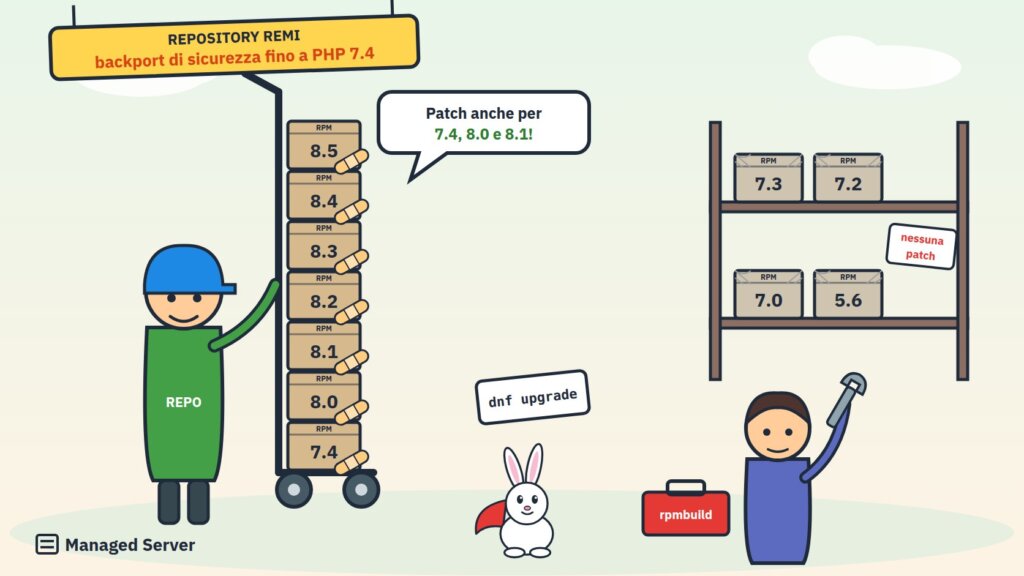
Over the past few days, we've been following the PHP2Shell story step by step , the two critical PHP vulnerabilities : first the early warning, then the leak, the public proofs of concept, and finally the official announcement with the fixed versions. In this article, we address an issue of close concern to those who manage Red Hat, AlmaLinux, Rocky Linux, or CentOS Stream servers: the role of Remi Collet's repository, which has made the fix available even for PHP versions no longer supported by the official project, starting with PHP 7.4.
What happened, in short
On October 21, 2026, the PHP project released versions 8.5.12, 8.4.27, 8.3.36, and 8.2.35 , which fix two critical vulnerabilities:
- CVE-2026-109618: remote code execution via internal request data corruption when PHP runs out of memory;
- CVE-2026-109619: Remote code execution via an internal state that survives memory freeing and is reused by a subsequent request from the same process.
Both can be exploited without authentication, affect all PHP installations that serve web requests (PHP-FPM, Apache with mod_php, php-cgi, FrankenPHP, LiteSpeed), and are accompanied by attack code that was already publicly circulated before the patches were even released.
The official advisory contained two important instructions for those using PHP on Enterprise Linux. First, PHP 8.1 and earlier versions no longer receive updates from the PHP project, although, given the severity of the situation, the security team has made minimal source fixes available for PHP 7.4, 8.0, and 8.1 for those who compile PHP themselves or do not have a long-term support provider. Second, those using the voluntary rpms.remirepo.net repository were advised to switch to the distribution's packages or compile from source, as the repository would not receive updates today.
Things went better than expected.
The Remi Repository and Why It's So Important
For those who work with Red Hat Enterprise Linux and its derivatives, the Remi Collet repository is an institution. Enterprise distributions offer one or two versions of PHP for the entire operating system lifecycle, often already out of date upon release. The Remi repository allows you to install virtually any version of PHP, even multiple versions on the same server, each with its own PHP-FPM: this is what allows thousands of hosting providers and companies to coexist on the same machine with a website running PHP 8.4 and an older management software that only runs on PHP 7.4.
Remi Collet, a long-time contributor to the PHP project, has maintained this repository for a long time, and one of its most appreciated features is its continued support for out-of-date PHP releases, with security fixes backported to older versions when possible.
Backport for PHP 7.4, 8.0 and 8.1
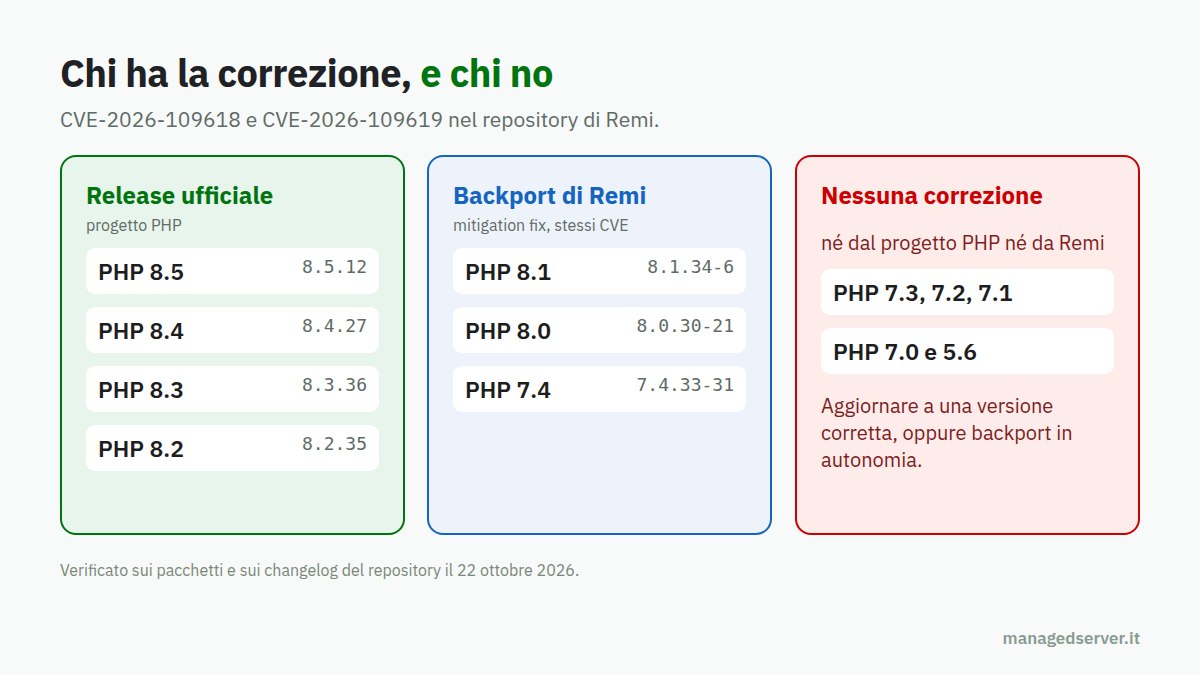
On October 21st, despite the official warning, updated packages appeared in the Remi repository for all supported branches and, importantly, for three branches no longer supported. We verified this directly on the published packages:
| Branch | Updated package | Type of correction |
|---|---|---|
| PHP 8.5 | 8.5.12-1 | official release |
| PHP 8.4 | 8.4.27-1 | official release |
| PHP 8.3 | 8.3.36-1 | official release |
| PHP 8.2 | 8.2.35-1 | official release |
| PHP 8.1 | 8.1.34-6 | back port |
| PHP 8.0 | 8.0.30-21 | back port |
| PHP 7.4 | 7.4.33-31 | back port |
For the 7.4, 8.0, and 8.1 branches, the PHP version remains the same, and only the package release number changes: this is a typical sign of a backport, i.e., a fix carried over from the new code to the old one. The package changelog confirms this, with the same entry for all three branches:
Mitigation fix: Avoid state corruption via bailout. CVE-2026-109618, CVE-2026-109619
The packages are available both in the form of separate collections (php74-php-*, php80-php-*, php81-php-*), which allows you to install multiple versions in parallel, both in modular flows (php:remi-7.4, php:remi-8.0, php:remi-8.1), for Enterprise Linux 8 and 9 and, where the branch is present, for Enterprise Linux 10.
Two important clarifications. First, Remi himself describes the change as a mitigation fix . It's the minimal fix prepared by the PHP security team for old branches, not the full set of changes for supported versions. Second, for this very reason, the backport is a solution to immediately secure legacy systems, not a reason to stick with PHP 7.4 or 8.0. Migration to a supported version remains necessary.
How to update
On a server using the Remi repository, the update process is the same as usual. For versions installed as separate collections:
dnf --refresh upgrade 'php74-*' 'php80-*' 'php81-*'
For those who use modular flows, just update the packages php-* with the flow already active. In both cases, it's a good idea to check that the installed package contains the fix:
rpm -q --changelog php74-php-common | head -5
The first entry should contain the two CVEs. Then there's the step that many people forget: restart all PHP processes, i.e. each PHP-FPM pool (e.g. systemctl restart php74-php-fpm) or the web server in the case of mod_php. As long as the old processes remain in memory, the vulnerable code continues to run even if the package on disk is updated. On a server with many PHP versions, it's easy to update five and restart four.
What about versions prior to PHP 7.4?
The news here is less good. No fixes have been released for PHP 7.3, 7.2, 7.1, 7.0, and 5.6 : neither from the PHP project, which has only backported 7.4, 8.0, and 8.1, nor from the Remi repository, where packages for these branches are stuck on versions prior to the vulnerability. Those who still have sites running on these versions have two options.
The right path: the update
Port the application to at least PHP 7.4, which currently has the fix, or better yet, directly to a supported branch of PHP 8. For a site built a few years ago, the jump from PHP 7.2 or 7.3 to 7.4 is often painless. Moving to PHP 8 requires more work on old code and outdated plugins, but it's the only solution that truly eliminates the problem, including future vulnerabilities.
The Way for Those Who Can't Wait: Homemade Backporting
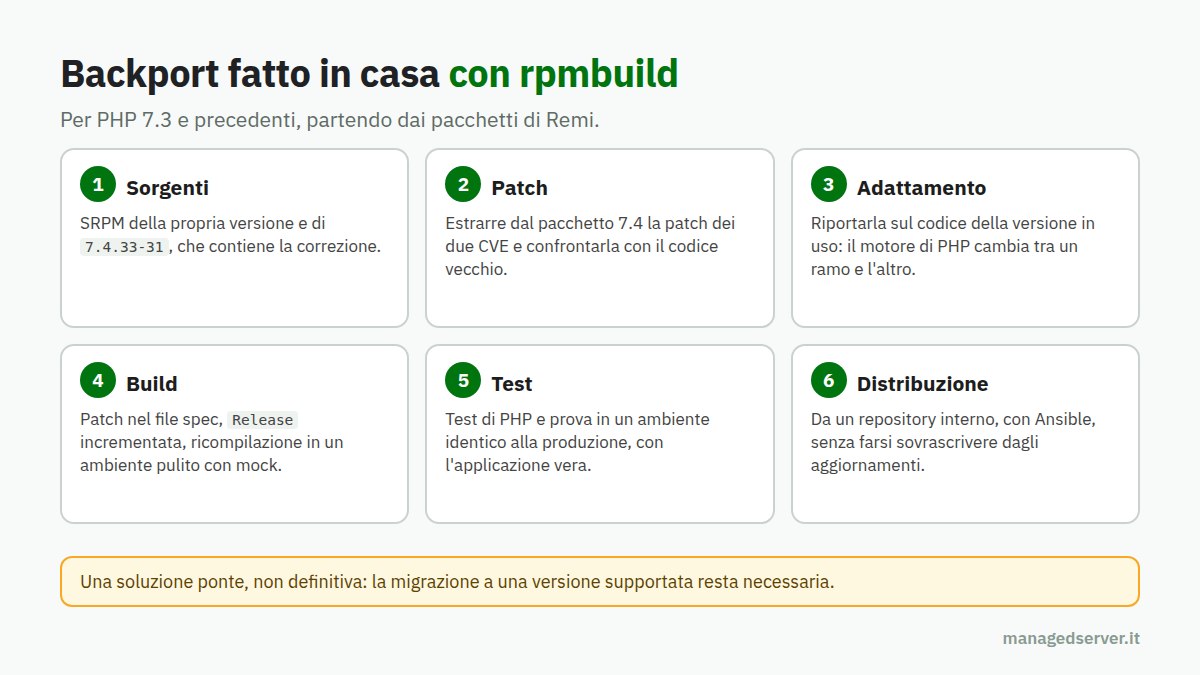
When migration isn't possible quickly, for example, for a management system whose code no one has anymore or an application that requires months of adaptation, you can still independently roll back the fix to the current version. For those familiar with rpmbuild , the best starting point is Remi's packages:
- download the source package (SRPM) of your version from the Remi repository, for example the one for PHP 7.3, and the one for PHP 7.4.33-31 which contains the fix;
- extract the patch added for the two CVEs from the PHP 7.4 package and compare it with the code of the old version;
- adapt the patch to the PHP 7.3 code or the version in use: the PHP engine changes from one version to another and a patch almost never applies without changes;
- add the patch to the spec file, increment the release number, and recompile the package, preferably in a clean environment such as mock;
- run PHP tests and install the package first in a production-identical test environment, verifying that the application works;
- Deploy the package into production from your own internal repository, so that future Remi updates don't accidentally overwrite it and deployment to multiple servers can be automated.
It's a job that requires serious skills: understanding the structure of RPM packages, knowing how to read and adapt PHP engine C code, and above all knowing how to verify that the fix works without introducing new problems. A poorly adapted patch can give a false sense of security or make the service unstable. And it should be considered for what it is: a bridge solution while waiting for the migration, not a permanent fix.
In the meantime: the mitigations
For all systems that cannot be updated immediately, the measures indicated in the official notice and which we have reported in the our previous article: deactivate session.upload_progress.enabled in the PHP-FPM configuration or in php.ini, reduce post_max_size, setting the memory limit so that applications cannot change it, using cgroup or container-level limits, and restarting all processes. These measures reduce the risk of some attack paths, but the PHP design is explicit: they do not secure an installation.
What are we doing?
As we anticipated, we are working with Ansible to patch all the systems we manage. The availability of Remi packages, including legacy branches, allows us to deploy fixes in a coordinated manner across all PHP versions on the servers, restarting each PHP-FPM pool and checking the changelog of installed packages. For customers still using versions prior to PHP 7.4, we will evaluate migration or other measures on a case-by-case basis.
If your server isn't managed by us and you need help upgrading, migrating an application from an outdated version of PHP, or preparing a backport for a system that can't be upgraded, our Linux system support is available.
Thanks to Remi
It's worth mentioning: on a day when thousands of system administrators needed quick answers, a volunteer-maintained repository made available fixes for seven PHP branches, including three that the official project no longer supports. It's the kind of silent work that powers a huge portion of the Internet, and which is usually only noticed when it's missing. If your business relies on those packages every day, consider supporting the project.
Sources
- PHP, “Security advisory: Critical remote code execution vulnerabilities, update now” dated October 21, 2026
- Remi Collet Repository, rpms.remirepo.net: packages and changelog verified on October 22, 2026
- Managed Server, PHP2Shell: Two Critical Vulnerabilities in PHP

