July 2 2019

BBR TCP: the magic formula for network performance.

How to speed up the download of a website for slow connections like 3G?

Improve network performance with TCP BBR

According to many, today's Internet does not move data as it should. Most of the world's cell phone users experience delays from seconds to minutes; public Wi-Fi at airports and conference venues is often worse.

For example, academic scientific researchers in physics or climatology departments need to exchange petabytes of data per day with global collaborators but find that their carefully designed multi-Gbps infrastructure often delivers only a few Mbps over intercontinental distances.

These problems stem from a design choice made when TCP congestion control was created in the 80s interpretation of packet loss as “congestion”.

This equivalence was true at the time, but it was because of technological limitations, not first principles. As NICs (Network Interface Controllers) have evolved from Mbps to Gbps and memory chips from KB to GB, the relationship between packet loss and congestion has become more tenuous.

Today TCP loss-based congestion control, even with the current best of breed, CUBIC11, is the main cause of these problems.
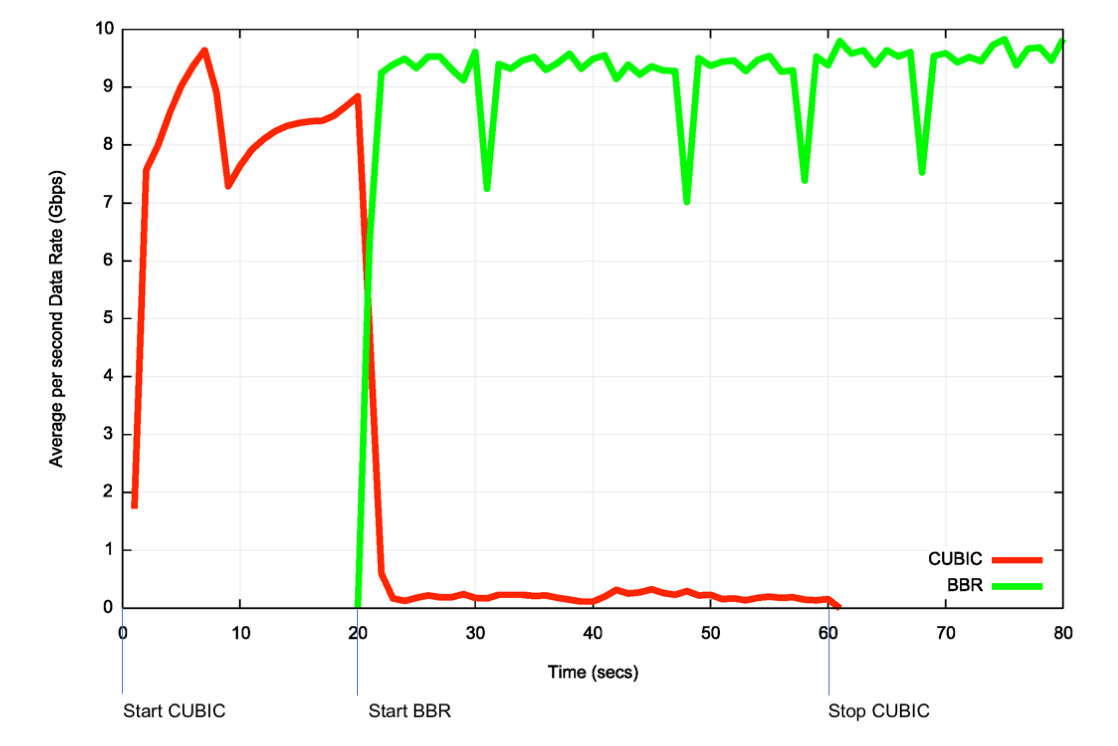
When bottleneck buffers are large, loss-based congestion control keeps them full, causing bufferbloat.

When bottleneck buffers are small, loss-based congestion control misinterprets the loss as a signal of congestion, leading to low throughput. Solving these problems requires an alternative to loss-based congestion control.

Finding this alternative requires an understanding of where and how network congestion originates.

This is where TCP BBR comes in. It is a TCP congestion control algorithm created for modern internet congestion.

TCP: Bandwidth sharing is important.

TCP tries to balance the need to be fast (fast data transmission) and balanced (sharing bandwidth for multiple users), with much more weight on being balanced.

Most TCP implementations use a backoff algorithm which results in about ½ bandwidth.

In short, if you have an outbound bandwidth of 1 gigabit per second on your server, you can be pretty sure that the outbound traffic for your web server running on TCP will hardly exceed 500 or 600 megabits per second.

This is the main problem with TCP, its use leads to waste (or rather useless) bandwidth.
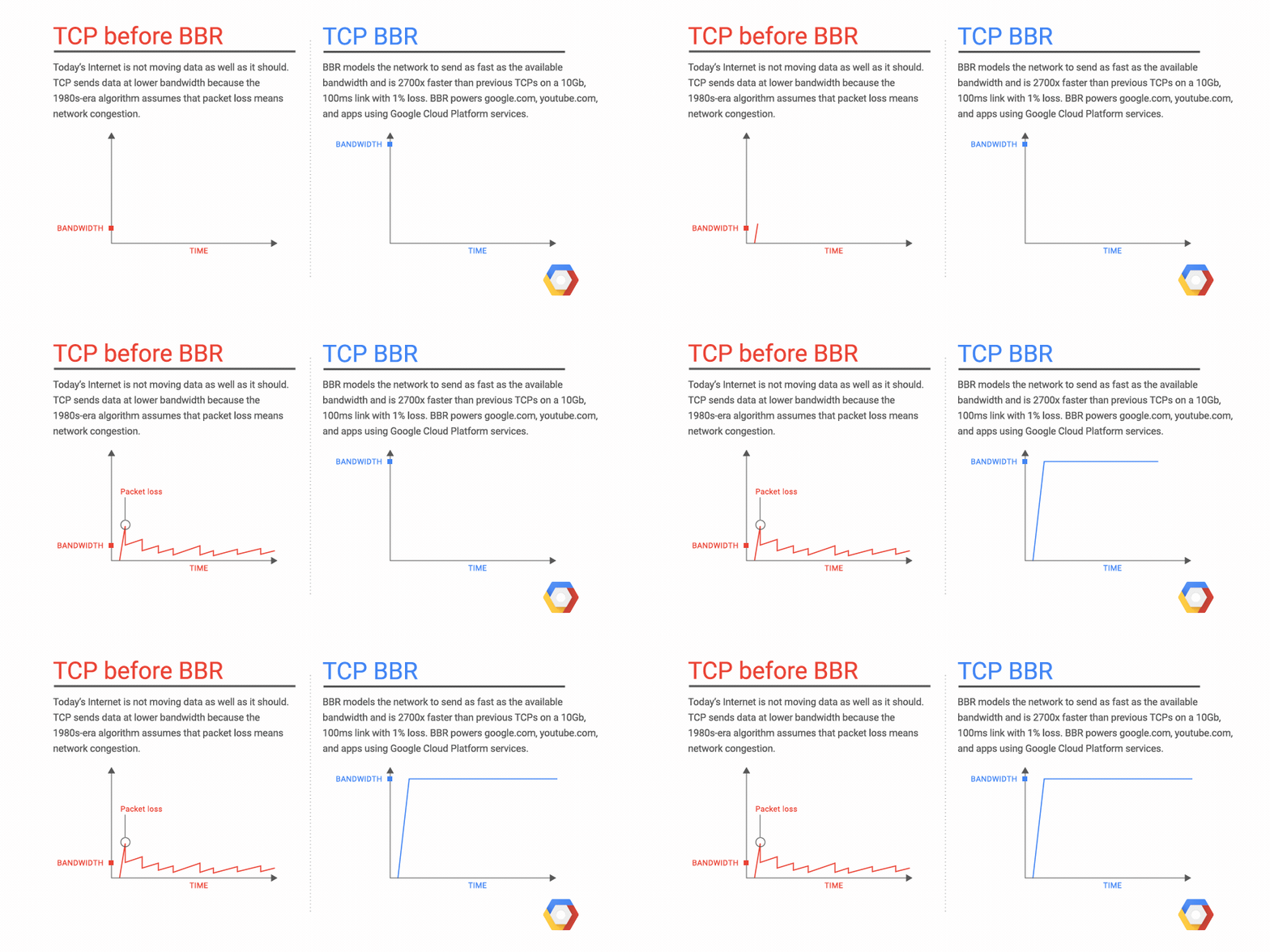
BBR TCP: the important concepts

you can read the document for more details, but the bottom line is that BBR is a congestion control technology that:

It is designed to respond to actual congestion rather than packet loss. The BBR team designed the algorithm with a desire to have something that responds to actual congestion, rather than packet loss. BBR models the network to send at the speed of available bandwidth and is 2700x faster than previous TCP over a 10Gb, 100ms link with 1% loss

Focused on improving network performance when the network is not very good. TCP BBR more accurately balances fairness and usage, resulting in better download speeds on the same network. It is most noticeable in situations where the network is damaged (however, it doesn't hurt if you are on a clean, squeaky network)

It does not require the customer to implement BBR . This is the real magic recipe. Previous algorithms such as QUIC required that client and server both implemented the algorithm. BBR does not require the client to also use BBR. This is particularly relevant in developing countries that use older mobile platforms and have limited bandwidth, or areas where sites and services have not yet made the switch. In short, if your browser does not support QUIC there was no way to improve anything.

Let's take a closer look at BBR on the road.

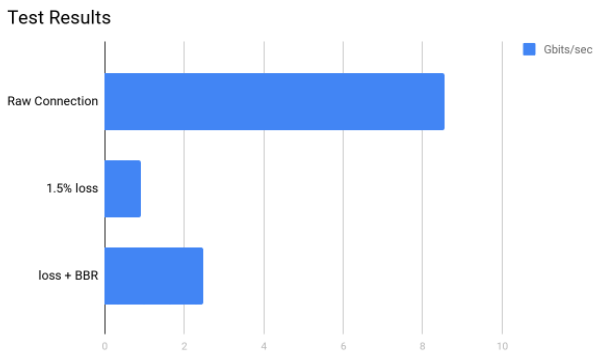
This all sounds good, but let's see how good this technology is in practice and not just in theory. To test things out, I set up two VMs in two different regions and ran a quick Iperf test to check their performance:

[4] 0.0-10.0 sec 9.97 GBytes 8.55 Gbits/sec

To simulate the ideal conditions where BBR is useful (high packet loss) we run the following tc command, which simulates packet loss at a certain percentage.

sudo tc qdisc add dev eth0 root netem loss 1.5%

When existing virtual machines connect, we see a significant drop in performance (which we would expect):

[3] 0.0-10.3 sec 1.10 GByte 921 Mbits / sec

So, we activated BBR, on the server side only using the following command (only available on Linux Kernel Major at 4.10):

sysctl -w net.ipv4.tcp_congestion_control = bbr

We performed the same Iperf e

[3] 0.0-10.0 sec 2.90 GBytes 2.49 Gbits/sec

We see almost 2 times a raw connection bandwidth usage just after having set a simple flag on the server.
 

Where to use TCP BBR? Everywhere.

Basically there is no real reason not to use a technology like TCP BBR and thinking about where it should be used and where not time would be wasted and perhaps even stupid.

Of course, most of the benefit will be seen on client endpoints in areas with bad traffic conditions . So if you switch it between VMs, don't be alarmed if things aren't significantly better. That said, there is no downside to using it, even in areas of good connection.

It must be said that among its non-standard uses that for example the implementation of BBR can help manage a TCP-based volumetric DDOS attack or Slashdotting effects where a website is reached by hundreds of thousands of visitors per minute.

Basically it is just a matter of enabling a Linux Kernel greater than 4.10 and enabling a flag, with a simple command line command.

Why not do it?

https://www.youtube.com/watch?v=4LBmFJXX5KU

Do you have doubts? Don't know where to start? Contact us!

We have all the answers to your questions to help you make the right choice.

Chat with us

Chat directly with our presales support.

0256569681

Contact us by phone during office hours 9:30 - 19:30

Contact us online

Open a request directly in the contact area.

DISCLAIMER, Legal Notes and Copyright. RedHat, Inc. holds the rights to Red Hat®, RHEL®, RedHat Linux®, and CentOS®; AlmaLinux™ is a trademark of the AlmaLinux OS Foundation; Rocky Linux® is a registered trademark of the Rocky Linux Foundation; SUSE® is a registered trademark of SUSE LLC; Canonical Ltd. holds the rights to Ubuntu®; Software in the Public Interest, Inc. holds the rights to Debian®; Linus Torvalds holds the rights to Linux®; FreeBSD® is a registered trademark of The FreeBSD Foundation; NetBSD® is a registered trademark of The NetBSD Foundation; OpenBSD® is a registered trademark of Theo de Raadt; Oracle Corporation holds the rights to Oracle®, MySQL®, MyRocks®, VirtualBox®, and ZFS®; Percona® is a registered trademark of Percona LLC; MariaDB® is a registered trademark of MariaDB Corporation Ab; PostgreSQL® is a registered trademark of PostgreSQL Global Development Group; SQLite® is a registered trademark of Hipp, Wyrick & Company, Inc.; KeyDB® is a registered trademark of EQ Alpha Technology Ltd.; Typesense® is a registered trademark of Typesense Inc.; REDIS® is a registered trademark of Redis Labs Ltd; F5 Networks, Inc. owns the rights to NGINX® and NGINX Plus®; Varnish® is a registered trademark of Varnish Software AB; HAProxy® is a registered trademark of HAProxy Technologies LLC; Traefik® is a registered trademark of Traefik Labs; Envoy® is a registered trademark of CNCF; Adobe Inc. owns the rights to Magento®; PrestaShop® is a registered trademark of PrestaShop SA; OpenCart® is a registered trademark of OpenCart Limited; Automattic Inc. holds the rights to WordPress®, WooCommerce®, and JetPack®; Open Source Matters, Inc. owns the rights to Joomla®; Dries Buytaert owns the rights to Drupal®; Shopify® is a registered trademark of Shopify Inc.; BigCommerce® is a registered trademark of BigCommerce Pty. Ltd.; TYPO3® is a registered trademark of the TYPO3 Association; Ghost® is a registered trademark of the Ghost Foundation; Amazon Web Services, Inc. owns the rights to AWS® and Amazon SES®; Google LLC owns the rights to Google Cloud™, Chrome™, and Google Kubernetes Engine™; Alibaba Cloud® is a registered trademark of Alibaba Group Holding Limited; DigitalOcean® is a registered trademark of DigitalOcean, LLC; Linode® is a registered trademark of Linode, LLC; Vultr® is a registered trademark of The Constant Company, LLC; Akamai® is a registered trademark of Akamai Technologies, Inc.; Fastly® is a registered trademark of Fastly, Inc.; Let's Encrypt® is a registered trademark of the Internet Security Research Group; Microsoft Corporation owns the rights to Microsoft®, Azure®, Windows®, Office®, and Internet Explorer®; Mozilla Foundation owns the rights to Firefox®; Apache® is a registered trademark of The Apache Software Foundation; Apache Tomcat® is a registered trademark of The Apache Software Foundation; PHP® is a registered trademark of the PHP Group; Docker® is a registered trademark of Docker, Inc.; Kubernetes® is a registered trademark of The Linux Foundation; OpenShift® is a registered trademark of Red Hat, Inc.; Podman® is a registered trademark of Red Hat, Inc.; Proxmox® is a registered trademark of Proxmox Server Solutions GmbH; VMware® is a registered trademark of Broadcom Inc.; CloudFlare® is a registered trademark of Cloudflare, Inc.; NETSCOUT® is a registered trademark of NETSCOUT Systems Inc.; ElasticSearch®, LogStash®, and Kibana® are registered trademarks of Elastic NV; Grafana® is a registered trademark of Grafana Labs; Prometheus® is a registered trademark of The Linux Foundation; Zabbix® is a registered trademark of Zabbix LLC; Datadog® is a registered trademark of Datadog, Inc.; Ceph® is a registered trademark of Red Hat, Inc.; MinIO® is a registered trademark of MinIO, Inc.; Mailgun® is a registered trademark of Mailgun Technologies, Inc.; SendGrid® is a registered trademark of Twilio Inc.; Postmark® is a registered trademark of ActiveCampaign, LLC; cPanel®, LLC owns the rights to cPanel®; Plesk® is a registered trademark of Plesk International GmbH; Hetzner® is a registered trademark of Hetzner Online GmbH; OVHcloud® is a registered trademark of OVH Groupe SAS; Terraform® is a registered trademark of HashiCorp, Inc.; Ansible® is a registered trademark of Red Hat, Inc.; cURL® is a registered trademark of Daniel Stenberg; Facebook®, Inc. owns the rights to Facebook®, Messenger® and Instagram®. This site is not affiliated with, sponsored by, or otherwise associated with any of the above-mentioned entities and does not represent any of these entities in any way. All rights to the brands and product names mentioned are the property of their respective copyright holders. All other trademarks mentioned are the property of their respective registrants.

JUST A MOMENT !

Have you ever wondered if your hosting sucks?

Find out now if your hosting provider is hurting you with a slow website worthy of 1990! Instant results.

Close the CTA
Back to top