

Table of contents of the article:
Sooner or later it would have happened, sooner or later we would have had to delve into a thorny topic that until now had been treated in a neutral way, or not treated, or rather the world of advertising.
We have always been neutral, super partes, not advising or discouraging brands of any kind unless explicitly requested by the customer who normally arrives already well structured with one or more advertising circuits on his site, sometimes alternatives to Google AdSense.
However, we cannot fail to describe a phenomenon that seems to be more frequent since January 2022, that is some advertising circuits under certain conditions can significantly compromise the ranking, the traffic and monetization of a blog or an online newspaper that monetizes through advertising circuits.
This unfortunately put us in the position of mere spectators to announced disasters, in which the interest of the advertising agency seemed to be not to keep alive and performing a customer who had hosted their banners in the long term, but a sort of guinea pig, a experiment, a lemon to be squeezed to be massacred with very heavy advertising that would transform a very fast or at least acceptable site into a terrible user experience, not only in the eyes of the visitor, but in the eyes of Google's yardstick.
Advertising circuits alternative to AdSense.
As we all know, Google AdSense is the leading choice for all those who have an interest in monetizing visits to their website, blog or newspaper. In a very simple way, advertising codes are inserted that will allow Google to show relevant advertisements to its visitors, using profiling and remarketing techniques.
Sometimes, it may happen that a blog owner, or a publisher more generally, may not be satisfied with the AdSense advertising revenue and rely on other circuits.
In other cases, however, while fully satisfied with the revenue, it can be encouraged by more profitable and attractive offers from some advertising agencies that guarantee a better remuneration per RPM every 1000 impressions.
It must be said that prices fluctuate significantly based on the number of pageviews, the click through rate (CTR), the type and theme of the site (a generic or gossip site will have a much lower remuneration than technology sites or finance for example)
Regardless of the revenue and the sector, however this is a fact, many publishers look for alternatives to AdSense and end up hosting different circuits on their site that significantly compromise the user experience, the loading speed and the overall weight of the page.
Core Web Vitals and advertising circuits ADS.
As we have previously specified in this article about Core Web Vitals and CRUX data, Google begins to enhance, reward or penalize what results from the user experience in the field, with the real data of the user experience and not that of laboratory tests.
A site that performs well tends not to be penalized or even rewarded in terms of traffic, ranking and visibility on the SERP.
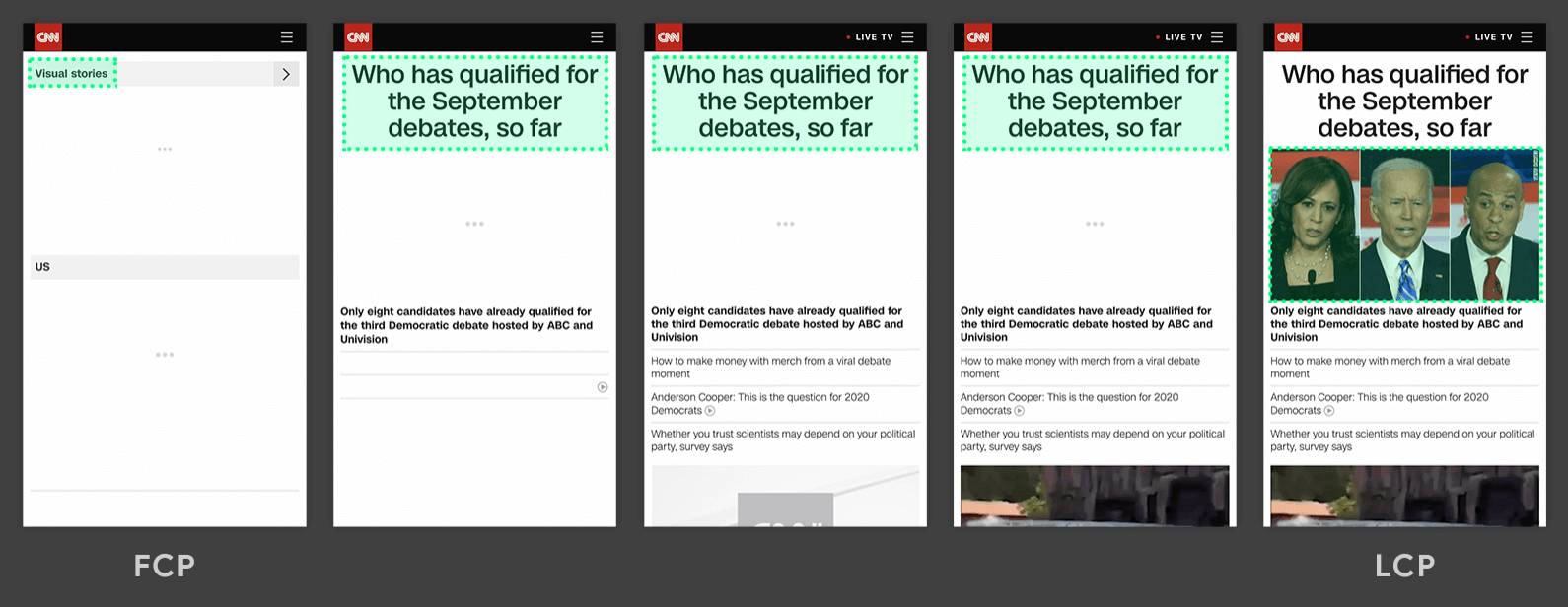
Many advertising circuits alternative to AdSense are very invasive, going to load banners in an incorrect way and creating that famous and annoying phenomenon of pagination that is better defined as CLS or Cumulative Layout Shift.
 Core Web Vitals" width="1590" height="616" />
Cumulative Layout Shift (or CLS) is a measure of how much a web page changes unexpectedly during its visit. For example, if a website visitor loads a page and, while reading it, a banner is loaded and the page jumps down, this would constitute a high CLS score.
Together with Largest Contentful Paint (the amount of time it takes to load the largest content) and First Input Delay (the time it takes for a page to be interactive or "clickable"), CLS is part of the Core Web Vitals by Google. Google's web crawlers measure the CLS on every page they index.
What causes the cumulative layout shift?
Page shifts occur when content loads at different speeds and causes the layout to change and alters what the viewer is looking at. Ads loading slowly, videos of unknown size appearing suddenly, or dynamically added DOM elements are all potential causes of CLS.
The following example shows what happens when a banner ad is loaded after the rest of the web page loads. The content is pushed down and the user experience is negatively impacted.

Traffic drops, visits drop and CLS value increase
When you decide to change an Advertising provider or an advertising circuit, you must always check and evaluate in the following month, what are the impacts that this change has had on your blog or online newspaper. Although it may seem tempting to have a revenue that pays double for the same number of impressions, you have to think long-term taking into account that the implementation and adoption of a circuit that does not suit your site can pay double or even triple compared to Adsense, but over the course of 3 or 4 months it could reduce your site traffic to zero due to user experience penalties, now more and more frequent with the intent of Google to provide a pleasant and fast user experience to its users.
In short, double or triple zero is zero, and it is perhaps better to be paid 1 euro for every thousand impressions for a site that makes a million page views per month, than 2 euro for a site that makes 200 thousand page views a month, with a collapse of 80% due to an absolutely inadequate CLS score.
Is the fault of the Advertising circuit or of others?
Put in these terms, one would therefore think that the problem is the Advertising circuit that is too heavy and cumbersome. However, a differential analysis on thousands of customers during 2022 has enabled us to state that the Advertising circuit is never a determining factor in worsening traffic or determining a penalty, but could however be a trigger.
Regardless of the Advertising circuits that claim to upload video adv heavy tens of mega, which is never a good thing on a purely theoretical level, it is also true that what emerges in an unobjectionable way is that an ADV circuit that loads its banners in a theme that tends to "spaginate" with a disproportionate and negative increase in the Cumulative Layout Shift, can determine a spiral and a succession of events in which week after week you see less traffic on the site and penalties in Google News or Google Discovery up to complete death of the site for what concerns traffic and monetization of the very little traffic left, not enough to continue and support the editorial adventure.

Almost always it is never the fault of the Advertising circuit itself but rather of specific situations in which a WordPress theme, for example, tends to page with a certain circuit, rather than another rather than AdSense.
If you contact the Advertising circuit, attributing the blame to them, they will be ready to motivate with thousands of other cases in which this problem that afflicts your site does not happen to others and therefore is not attributable to them, having in fact at least formal reason full. .
From a purely substantial point of view, however, it would have been more correct to communicate that that circuit, on that theme, generates non-trivial problems that in the long term will decree the death of the site.
Precautions in changing ADS circuits alternative to AdSense.
As a cornerstone in operational research teaches us, we must always try to maximize profits and also minimize costs, sometimes we find ourselves being the tip of the balance and having to make theoretically weighted choices but never certain.
In this regard, our dispassionate advice, in an attempt to protect you and warn you from bad experiences we have seen on our customers, is to carefully evaluate and weigh the risk and benefits.
Always make sure of the invasiveness of the advertisements of the alternative circuit to AdSense, of their weight, of the third-party resources that need to be loaded, and always measure the speed of the site through Google PageSpeed Insight and the CRUX values inherent to the mobile user experience on mobile devices directly in the Google Search Console.
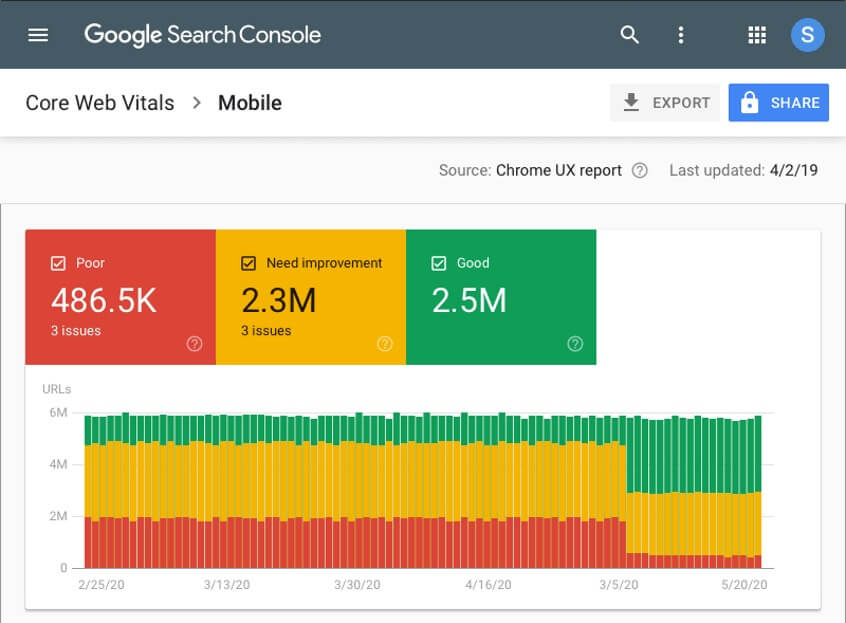
If you observe a significant worsening of the user experience and find a sharp drop in traffic and positioning, take care to review the theme and the integration of the advertising circuit so that the Cumulative Layout Shift problem is solved or in any case it is as low as possible.
It should be remembered that although we are focusing a little too much on the CLS parameter inherently in advertising, it is also true that this is not the only parameter Core Web Vitals which could worsen drastically with the change of the Advertising circuit.
Offer a better user experience with CLS optimization
Paying attention to CLS not only provides a better user experience, but also increases the ranking of search results. It is a win for everyone.
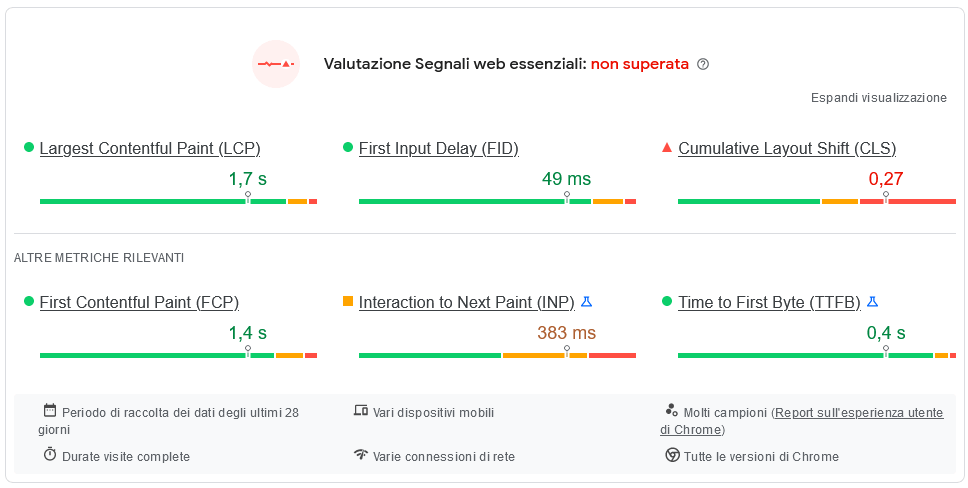
To meet Google's standards for CLS, start by using a diagnostic tool to measure your website's current performance. Consider the basic guidelines outlined above and keep layout changes foreground when designing your website, especially with regards to transitions and content additions.
With these few simple considerations, you will see better results across the board.
What to do if the site has sudden traffic drops?
The basic rule is to always keep track of every variation, modification, update, change that we have made to our site and monitor both the tools of Google Search Console and Google Analytics what are the positive or negative changes we are undergoing, looking for to correlate them to any internal or external events.
Even third party tools such as SEOZoom o SemRush can be very useful for analyzing and understanding events.
For example, an internal event could be the use of non-optimized formats or the change of hosting to another one naive supplier as we have seen in this case, an external event instead could consist of a Google Core Update that changes the rules of the game for everyone and to which you will have to conform and adapt in order to continue playing.
An external consultation with an SEO can certainly give you support where you have difficulty in identifying the cause, and yet the problem of site speed and user experience is a problem that can be solved by deciding for a short period of one month to NOT post advertising on the site. Neither that of Google AdSense, nor that of alternative circuits.
We understand how difficult it can be to accept psychologically and emotionally the choice not to monetize page views, but this experiment must be inserted within a broader plan that we could call "The cure".
An extremely technical and professional approach materializes wherever the professional, devoid of any emotional involvement, approaches the resolution of the problem by measuring and then deciding, aware of the immediate evil to be sustained in order to achieve a greater good.
Therefore, face a differential analysis and understand if it is actually the newly adopted advertising circuit that has decreed our imminent failure and understand how to mitigate or better solve the problem by intervening perhaps on the issue or by opting for a total and complete replacement of the same.
In cases where you do not want to solve the problem, replacing the theme and intervening at the application level, you can try to return to the use of Google AdSense which would certainly remain the safest choice among those available.
Conclusions
We have seen how today at the threshold of 2023 we can no longer afford the luxury of not respecting the teachings that Google discloses and to which it expects us to adapt. As Darwin teaches, It is not the strongest of the surviving species, nor the most intelligent, but the one that adapts best to change, and this concept is valid more than ever to guarantee an online presence in compliance with the directives outlined by Google, a good but strict teacher.
On a purely psychological level, you need to have that strength and awareness in understanding the causes and effects as well as the risks of making changes to your site, such as replacing an advertising or advertising circuit with one that promises and undertakes to pay more. at the expense of your traffic that could (conditioning is a must) go down.
For correctness and completeness of information it is good to highlight how this article is not intended in any way to be a prohibition or advise against the use of alternative circuits to AdSense but have the function of a warning and invite the user to evaluate the changes in place and the goodness of the same on his business, in a long-term perspective.
An advertising circuit can revive the fortunes and finances of a blog, or bury it until it fails.
